
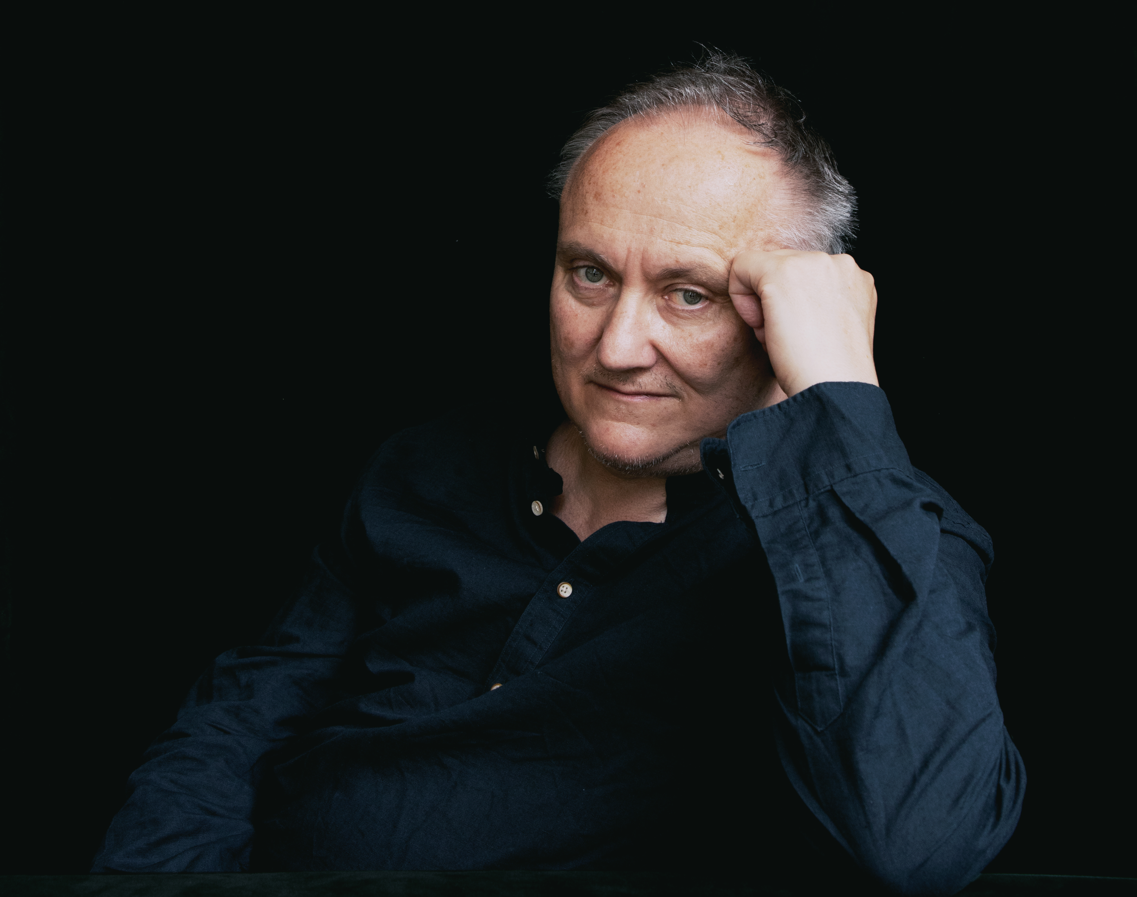
Mark Springer – a renowned avant-garde musician and co-founder of Rip Rig and Panic – returns with a new large-scale project. His album “Sleep of Reason”, inspired by Goya’s dark imagery and the challenges of the modern world, blends classical music, jazz, and chamber compositions. The legendary Neil Tennant (Pet Shop Boys) took part in the recording, and his poignant vocal contribution gives the project a special depth. On the eve of the release, we spoke with Springer about the nature of evil in art and reality, musical risks, and how a “monster” of the 21st century is born.

We are very pleased to meet you, Mark! Your grand double vinyl album and CD “Sleep of Reason” is truly a monumental project. Do you ever feel that in a world where music is becoming shorter and more instant, such an ambitious release is a challenge to the listener?
I feel that it is my job to challenge and surprise the listener up to a point! I like to think that all my releases over the years have something challenging about them. Just because I play the piano or write for what is a long standing traditional group of instruments, like a quartet, I am still looking for new ways to explore sound. In SOR, I went against preconceptions, with Neil Tennant’s voice combined with a string quartet there is a surprise in itself. Neil’s vocal amongst 4 totally acoustic strings is a departure for us and hopefully the listener too. Then I also wanted to compose a longer series of works that will intrigue the listener and be a challenging way to go on a longer musical adventure and to see how many ways I can remake the sound in each of the 3 sections; piano solo, string quartet and the quintet.
You decided to open the album with “Phantoms and Monsters” – in my opinion, a mystical and dark track. What is the real reason behind this choice – the desire to shock, or is it something more personal than just a musical move?
Well, the quintet piece of SoR, was written as you hear it and I was excited that Neil was so connected to the music that he created his series of lyrics and atmospheric vocal throughout this part of the whole work. It was as much Neil’s idea too for the album to start with the Quintet piece. I think he felt too, that the quintet would introduce the mood of the whole work and we both agreed it would be a good opener and a perfect way into the dark considerations of Goya’s visions and his commentary on social injustices; the power imbalance in his day and, also, how that superimposes onto the current anxieties of the times we all live in now.
Your music is bold and experimental, you are not afraid to move away from conventional forms. Today, when culture is increasingly shifting to algorithms and fragmented thinking, do you think your new album “Sleep of Reason” speaks about a temporary clouding of the mind, or are we already witnessing its final death?
It was a deliberate decision for me to make a more substantial statement that can carry a larger weight of ideas. It’s a way to get away from the sound bite culture that’s so prevalent and if you take a challenge to get beyond the predictable algorithms and snack size thinking then you can plunge in fully to another world! I would like to cut through the clouding of the mind, as you put it, and shatter some of the screens we can easily put up with all the current noise that’s thrown at us.
Francisco Goya created his etchings during a time of social upheaval, war, and censorship, reflecting the horrors of his era. Today, we live in a world where fears are broadcast 24/7 through screens, and monsters often disguise themselves as the mundane. What do you think is more sinister – Goya’s ghostly creations or the monsters we don’t even notice around us?
Well our current monsters are the most sinister as we are living with them now! I know that Neil wants his lyrics to reflect the present moment as much as any past goya-esque reality. There are obvious hypocrisies going on now that people are witness to or are experiencing directly. I am listening out to the sways of voices and images around and so perhaps the music and lyrics may intimate that in parts of the work while also being subject and prone by the power of the times.
I have become familiar with your early works “Matter,” “Army of Lovers,” “The Rip Rig & Panic Piano Solos,” and I want to say that your music has a cinematic scope; for me, it evoked powerful images and emotions. While creating “Sleep of Reason,” were you composing pure music or perhaps hearing a soundtrack to a film that exists only in your imagination?
Whenever I have written music for film I have had to work to a brief which usually consists of segments that are composed to small sections of film. That process is very different from working on larger and longer full scale compositions where I can fully explore musical motives, unhindered by any interruptions or outside influences. I do enjoy writing music to film as I think my music does seem to create very strong visual images in the listener’s imagination but, to really challenge the listener, I need to go deeper into my own sound world.
It seems to me that the new album is like a puzzle in three parts – piano, string quartet, and quintet with voice. Was this an intuitive format choice, or did you deliberately separate the ideas, like a director assigning roles in a complex drama?
Well that’s interesting! If it’s a puzzle, that’s no bad thing as it will challenge the listener and keep you guessing about what’s next! I wanted to explore and find out how many ways can I remake my musical journey but still stay with some of the fundamental ideas in the music and I can keep going – perhaps a SOR part two, with a full orchestra next.
Mark, in the music industry, you are known for your ability to connect different musical worlds, and your collaboration with Neil Tennant is a vivid example. What do you think is common between chamber music and pop culture, and what could happen if these two worlds collide in your “nightmare”?
I am searching in life and in music as they are the same thing for me. I am a restless being, from early on, even as a youngster, I was always trying new ways to play some of the pieces I was being taught, like a Mozart sonata where I used to try to change the parts or see if I could improvise around Mozart’s ideas. I don’t think about joining genres together especially but I am to some extent a person who explores different musical ideas and I will carouse along the way to make a musical idea come into existence whatever that may be. I don’t think we should be limited musically into only going one way. Chamber music is a very intense intimate medium to express music – a string quartet is a little orchestra with low, mid and high sound possibilities, actually very similar to a lot of groups that are around now with bass, drums, guitars and vocals. I think SOR is a collision, sometimes a nightmare but also sometimes a daydream.
Neil Tennant is certainly not the first person with whom your name could have been seen in a collaboration. What made you choose him for this project?
This was a very unforeseen collaboration. Neil spotted a review he had written for Smash Hits a long way back . In the review he wrote about how much he liked my solo piano on the B side of a single and he went online to listen to some of my current work. He really liked it and bought some current CDs including string quartets and opera from exit.co.uk Sarah Killery, the artistic director of the Exit Label, said to me that she could hear Neil’s voice instead of an opera voice on my original SOR score which I had written 6 years ago and put aside after the monster nightmare of the Covid Pandemic. This moment of random chance brought Neil and me together and we decided to have a go on something new and hence Neil is the voice on the SOR quintet.
Recording a quintet is a tense and detailed process. Were there moments when things didn’t go according to plan, and you thought, “This is definitely not what I envisioned?
The works were built up in stages. The strings were recorded in the UK at the Yehudi Menuhin Hall, which has a lovely acoustic, over a few days with deep concentration on my part, focusing in on the details and intricacies of the piece and The Sacconis fused together to make a really good reading of the work. Later, Neil and I added the vocal in the Pet Shop Boys studio. It was fascinating to watch Neil at work as he has a great intensity and energy! Everything in the recording process was going really well so, for the final section of the opus, I travelled to Brussels to record the piano solo which is one hour long and demands full commitment. To play with high concentration was great. At one point, towards the end of the session, everyone was really pleased with the sound but I suddenly said “HOLD ON it’s not right!” and we had to loose some microphones and remake it again to get all the detail I was looking for. Last moment shifting but it worked in the end as I am now happy with the piano sound.
Your work spans many genres – from punk to classical. With such a wide range of styles, can we say that you have already found your perfect musical “place,” or are you still in search of that particular sound that will become your true home?
In many ways, my work is always specific to me in the way that I hear music. I don’t feel that genre means a lot to me. Currently, I have been performing solo piano music that I have called ‘compositions in real time’. With these pieces I am going out on stage and using the atmosphere, acoustic and that particular environment in the hall to spontaneously compose music – which I deferentiate from improvisation – it finds its own place, outside of styles and idioms. I more find what I’m after, then search for it!



 Voxwave Magazine: Music, Culture, Interview, Fashion