
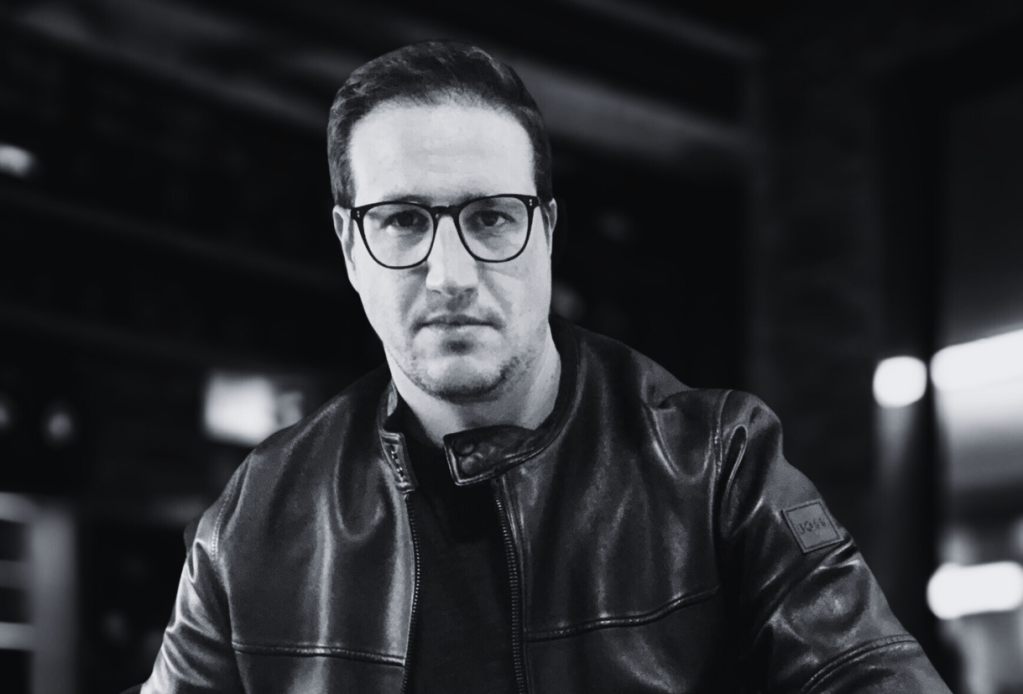
Nikola Pešić is a pianist and composer with Serbian roots who has been living in Switzerland for a long time. There are musicians who tell stories with words. And there are those who know how to remain silent in such a way that a whole world sounds within that silence. Nikola is one of them.
His music is like a light breeze: barely perceptible, yet it changes everything around it. Recently, he released his new album “Skies“, and we met to talk.
We dreamed a little together, laughed, and talked about why sometimes it’s easier to say a lot with just a few sounds.

Hello, Nikola! Thank you for taking the time for this conversation! Let me start a bit further back. The sky is often associated with something infinite – dreams, freedom. Your album is called Skies – in the plural. Why exactly that choice?
Thank you for having me. I’m truly happy to share some thoughts and stories with the readers of Voxwave Magazine. The idea for the album title actually came a bit later. Initially, the working title was Made of Hope. But during that period, I was going through a lot of self-discovery and came to fully embrace the idea that every person has their own path, their own uniqueness, their own story – and, in a way, their own sky. That’s why I chose Skies in the plural. I wanted to unite all our skies and make the listeners an integral part of this musical collection. After all, there isn’t even enough evidence to claim that the sky is just one.
You mention that many of the pieces came to you through improvisation. Does this mean you didn’t know where the storyline would take you until you finished the work?
Exactly. Most of the storyline unfolded during the creative process itself. It’s a thrilling experience, where the moment decides the details – and those details end up feeling like the only logical choice. It’s a bit like a form of psychotherapy, where you have to confront and accept different parts of yourself along the way. However, some tracks, like Stara or Made of Hope, were my musical responses to events I simply felt I had to capture in sound.
I listened to your album, and the tracks La Valse d’Azur, Skies, and Light White made a strong impression. Each carries its own unique meaning. But if you had to pick just one, which track is the closest to your heart?
Thank you – I’m glad Light White resonated with you.
Hmm… if I had to choose just one, it would probably be In the Circle. Not only because of its G minor tonality, which feels very close to me, but also because from the very first note, it takes me straight back to my childhood – a time I look back on with fondness, despite the two wars in my homeland, Serbia (then Yugoslavia), the total isolation from the rest of the world, and so many dreams that never came true.
The creative process is always multi-layered, and each stage brings its own challenges. When you were working on Skies, what turned out to be the most difficult: creating the music, conveying emotions through the compositions, or perhaps external aspects like marketing?
Looking back, the creative part felt very natural and easy. I didn’t make any compromises or overthink it. I wanted each composition to have its own identity – something I could still recognize thirty years from now. There were moments of doubt, wondering if something was truly finished, but I never rushed. Some pieces were even deleted along the way. I spent more than a year just searching for the right title for Light White! Many people were involved. Everything else – the business side of music – was far more difficult. I was still learning how that world worked.

In an era when music is more often skipped with a swipe than played on a record player, you decided to release your album on vinyl and CD. Was this a romantic attachment to retro formats, or a confident challenge to the digital world?
It’s a limited edition release on vinyl and CD.
I love the ritual of listening to music – that feeling of connecting with the artist. Vinyl is actually becoming popular again, especially among younger generations who are resisting the speed, overproduction, and virtual overload of today’s world. With vinyl, the music is yours – no ads, no internet connection needed, no algorithm telling you what to listen to next.
Minimalism in music is a bold route – saying more with less. You describe yourself as a minimalist. Is that rooted in a deeper artistic philosophy, or is it a subtle form of resistance to the noise of modern life… and maybe just a tiny shortcut away from maximalist complexity?
I love minimalism in every sense, even though my nature sometimes leans toward the opposite. I enjoy minimalist food, clothing – and of course, music. I find it inspiring to say as much as possible – or simply enough – with as few tones as possible. As I grow older, I appreciate more and more the importance of simple but essential things. I’m no longer preoccupied with details or the need to impress with complex forms or virtuosity. So for me, minimalism isn’t just an artistic or aesthetic choice – it carries a deep philosophical and psychological meaning as well.
When I watched your videos on YouTube, I couldn’t take my eyes off your hands. Every movement of your fingers seemed like a spell, as if you were speaking a secret language to the instrument. Is this the result of a long search, a unique technique – or pure magic?
Hm… I don’t have any experience with magic, but it’s probably a little bit of everything.
There’s a long path of education, searching for a unique technique, and striving for a personal mode of expression behind me. I think my musical elasticity gained a new level of freedom once I started creating my own music. My goal has always been not to separate myself from the music – but to become one with the instrument, with the sound.
They say every musician behind an instrument tells a story: some become magicians, some philosophers, some mad scientists. What about you – when you sit at the piano, who do you feel like?
A cinematic hypnotist. [laughs] What an interesting question! I’ve never really analyzed it in detail. I think I switch roles depending on the moment. I’ve often heard from audiences that I have an unusual ability to tell a story through music – and to hold their attention until the very last tone. My mission is to connect with the audience, and allow them to connect with me. It’s a sincere and open relationship that allows the listeners to truly understand and react to my music. On stage, I also feel like I can be whoever I want in that moment.

You clearly don’t like limiting yourself to strict genres – your music dances freely between styles. But if you had to pick just one genre, purely for fun, which one would it be?
It would definitely be contemporary classical music. Most people who’ve heard the album told me it sounds like film music – and that was exactly the intention. I wanted listeners to surrender and create their own movie. I never intended to fit neatly into one genre or niche. Even though some tracks, like Rain and Stara, Skies and Always and Forever, are stylistically very different, I believe the story behind them ties everything together into one coherent musical journey.
Nikola, you’ve been living in Switzerland for a while now – a country built for tranquility: mountains, perfect order, chocolate… But with your Serbian roots – noisy gatherings, passionate music, vibrant energy – do you feel a contrast between these two worlds?
I’ve been living in Switzerland for eleven years now. The differences between Switzerland and Serbia are enormous. There are stereotypes about both – one country is often overly idealized, while the other is met with skepticism. It takes time to develop a real, nuanced impression. Switzerland is a fantastic place, incredibly multicultural, full of artists and people from all over the world. I love the Alps and nature. But I’m often in a sort of continuous fast-forward mode. In Switzerland, I feel a strong sense of security and connection to the present. In Serbia, however, the emotions and memories of my childhood are deeper and more vivid – as if time has somehow paused there. The contrast between these two worlds is something I try to draw the maximum from every day – in friendships, in teaching, and of course, in my creative work. This blending of influences is a powerful source of inspiration, and I think it has a strong presence on Skies as well. The album is, in many ways, the story of that journey – from Serbia to Switzerland, with stops all over the world along the way.




 Voxwave Magazine: Music, Culture, Interview, Fashion