
A skiing injury, months of recovery, it seems that life is put on pause. But it was precisely at this moment that something clicked – producer and performer John Hayes from Denver decided to change his sound and wrote a new album “Closer,” which came out on January 16th. Known for his intimate piano compositions, this time he went into melodic electronica with clear beats and dance energy. We spoke with John about the pursuit of the perfect sound, collaborations, and why sometimes you need to let go of control.
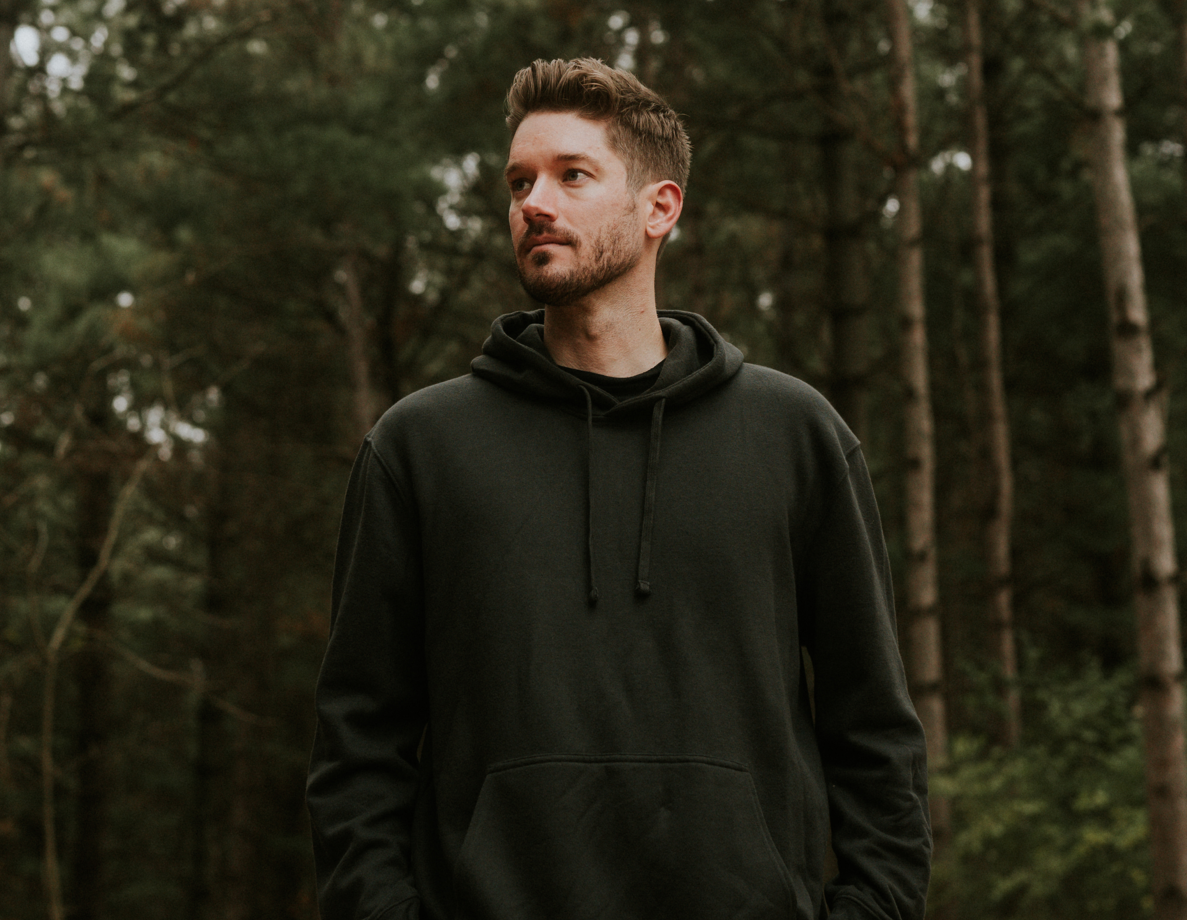
John, hello! Glad that we found time to talk before the release of “Closer“. You wrote it during recovery after a serious skiing injury, when for several months you couldn’t walk. And it was precisely then that the most danceable and rhythmic music in your career came out. Psychologically, creatively… do you think the two events are connected?
I do think there’s a real connection there. Whether it was conscious or not, there was a constant sense of restlessness and frustration during my recovery that definitely found its way into the music. I was basically confined to my couch for about four months, and I couldn’t even spend long stretches in my studio because the doctors were worried about blood clots in my leg.
For a long time I couldn’t go to shows, dance, or even move freely, and I think that absence played a big role. Writing more rhythmic, dance-focused music became a kind of outlet, kind of a way of reconnecting with the physical side of music at a time when my body was holding me back.
Let’s talk about the new release. Closer“.. What exactly does this title mean to you?
I’m sure I’m not alone in this, but for me, and for a lot of musicians I’ve talked to, it feels like we’re always chasing the music we hear in our heads. That imagined song or sound where you think like, “this is it, this is what I want to make”. That constant pursuit is a big part of what keeps me coming back to writing music.
Having said that, I think it’s incredibly hard to ever capture that vision exactly the way you hear it internally. To me, Closer represents that process: this ongoing pursuit of a sound and feeling that truly lights me up. Each record, each attempt, feels like I’m getting a little closer to that feeling, even if the chase never really ends…
Balance between intimacy and epic scope is a real challenge. And you mentioned that you wanted the album to work equally well both in headphones and on stage. But these are completely different listening contexts. How to find the golden middle between intimacy and power?
That’s a great question. I think for me, it really comes down to emotion and the feeling of the track being the common thread. Whether I’m writing something energetic for a live setting or something more introspective and headphone-focused, I’m always asking the same thing: does this idea spark some kind of an emotional response? If that core feeling is there, the context is almost secondary. Even a 140 BPM track can feel intimate if it’s grounded in feeling, and those are the kinds of songs that translate well everywhere (at least in my opinion) alone with headphones or in a room full of people. That emotional connection is what allows the music to feel powerful on stage without losing its sense of closeness.
Having listened to the album recording, I got the impression that your music speaks for you. Do you ever think of yourself as a storyteller, not a producer?
I’ve never really thought of myself that way, but I understand what you mean. I’m definitely trying to let the track lead the listener somewhere. I’ve always been drawn to music that sets a scene and slowly pulls you into it, rather than spelling everything out directly.
When I’m making music, it’s less about telling a specific story and more about creating a world for the music to exist in. Sound design, space, and atmosphere play a big role in that. I tend to use a lot of reverb (sometimes probably too much) but for me it’s a way of creating a physical and emotional space where the rest of the track can live and unfold naturally.
Personally I liked the tracks “For Now”, “Not Enough” and “Closer”. But you point to the track “All the Memories” with il:lo as one of the key ones on the album. Creative chemistry between producers can be an unpredictable thing. How did this collaboration go?
Those are three of my favorites as well. All the Memories actually came together very organically. I had been playing an early version of the track live for a while and had more or less considered it finished. At the same time, the guys from il:lo and I had been talking about collaborating again, and I really wanted them to be part of this album.
On a bit of a whim, I reached out and sent them a handful of tracks I was working on, and All the Memories immediately stood out to them as the one they wanted to dive into. Collaboration can be tricky, especially when you’re working across countries, because it requires giving up a bit of control and trusting someone else with your ideas. But with il:lo, that trust came naturally. We have very similar musical instincts, so it felt easy for me to step back and let them bring their perspective to the track. I’m really proud of how it turned out.
You road-tested many tracks from Closer at live performances, refining them in real time. Your audience didn’t even suspect that they were participating in beta-testing?
Not really, at least not consciously. There were usually a few friends in the crowd who knew what was going on, but for everyone else, they were just hearing the music as it was in that moment. In a way, that kind of made it the perfect testing ground. I think it really gave me the freedom to play the same track very differently from one show to the next without any expectations attached. I could stretch parts out, change arrangements, or see how certain moments landed in a room, all without the pressure of the audience thinking, “this is how the song is supposed to go” if that makes sense? That flexibility was really valuable in shaping how the final versions ended up sounding.
Piano was always your main instrument, but in “Closer” it clearly took a back seat for the sake of beats and synthesizers. It seems your music became more mobile not only rhythmically, but also emotionally. When did you first feel that the piano was giving way to the drum machine?
I was actually making electronic music and beats in the background for a long time, even while I was releasing solo piano work and albums like Beautifully Lost Mind. It was always something I wanted to put out into the world, I just didn’t feel like it was fully there yet. That confidence really started to click right around the time I put out my Bloom EP. The piano is still a huge part of my process, though. I play it almost every day, and many of the simpler motifs on Closer started as piano ideas. The main melody in the title track, for example, actually comes from muted piano strings. I think part of why I’m so drawn to the piano is that it always has a place. Sometimes it’s front and center, sometimes it’s buried beneath layers of drums and synths, and sometimes it’s just the tool that helps an idea come to life. It’s almost always there in some form.
When you listen to your piano compositions, does the desire arise to return to live keys – or has the electronic world captured you so much that you don’t want to look back anymore?
I still play the piano almost every day, so that connection never really goes away. Right now, my creative focus and interests are definitely more centered on electronic music, but I don’t see it as a permanent departure or an either or situation. Piano has always been a foundational part of how I write and process ideas, and I can definitely see myself releasing piano-based work in the future. For me, it’s not really about leaving something behind and more about following where my curiosity is at any given moment.
If Closer becomes your most definite artistic statement, how are you going to surpass this next time?
I tend to think of every release as a kind of journal entry, sort of a snapshot of where I was at creatively, technically, and emotionally at that moment in time. Because of that, I kind of shy away from labeling any one record as a “final” or defining statement. What really excites me most about making music is staying curious: learning new techniques, discovering new artists, and letting my interests evolve naturally. As long as that curiosity is there, I’m less focused on trying to surpass something and more excited about seeing what comes next.



 Voxwave Magazine: Music, Culture, Interview, Fashion