
For many, the song “Twinkle, Twinkle, Little Star!” was the first melody they learned in childhood. It’s simple and memorable, perfectly suited for beginner musicians. However, in the hands of composer and musician Alkis H, this little song turns into a captivating symphonic work. The musician is known for his mastery in classical and theatrical styles, and in his new album “Twinkle, Twinkle – 12 Variations for Symphony Orchestra”, he reveals a completely different perspective on a familiar theme.
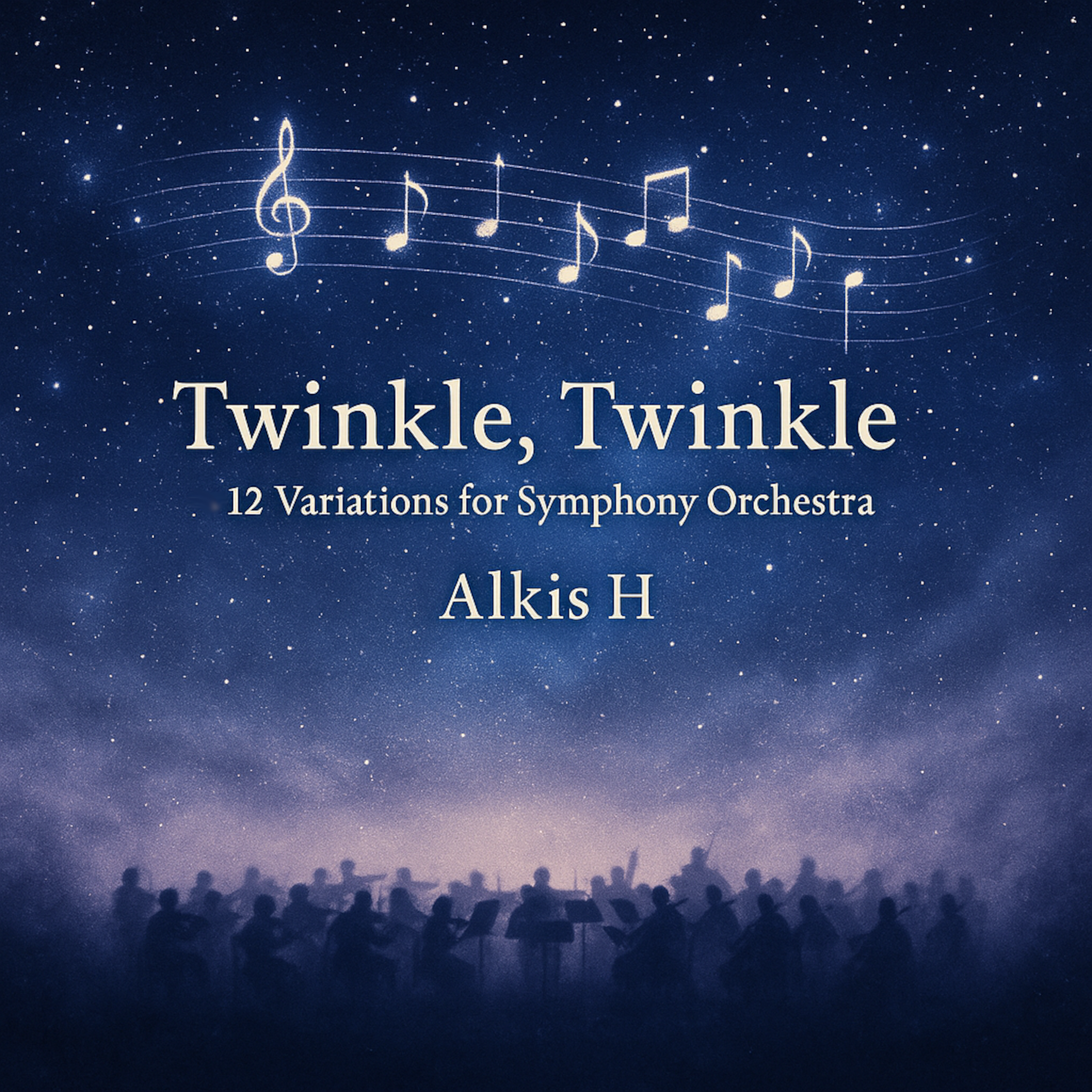
The entire piece is built as a single arc: despite a constant tempo, the atmosphere shifts thanks to new instrumental colors and expressive discoveries in each section. In the first section, “Woodwinds: Simple Origins”, woodwinds dominate with playful and transparent sound. Imagine the sound of a flute, with its gentle, I would say sparkling timbre, lightly fluttering above the melody. The clarinet adds its own special color – sometimes bright, sometimes more lyrical. These instruments lay the unpretentious foundations of the theme, making it accessible to perception. Then, in “Strings’ Grace”, the strings enter, bringing refinement and grace, thus revealing the lyricism of the melody. They add emotionality, transitioning from clarity to melodic expressiveness. The melody, which begins like a gentle breeze, gradually becomes complete.
A shift in mood comes with “C Minor” – here there is a transition to minor: the harmony becomes pensive, gaining melancholy and drama. The melody takes on new, rich shades: the sound thickens, soft shadows appear, and the familiar motif recedes into depth, revealing new and unexpected nuances. This very turn sets the emotional perspective of the piece, contrasting with the preceding lightness, and opens space for further development of the theme. The next variation, “Brass Resonance”, is given to the brass – their resonance fills the music with grandeur and solemnity. Yet the xylophone’s dance on the track “The Dance of the Xylophone” unexpectedly brings in playfulness: the thematic line breaks apart, scattering into percussion patterns. The musical stream seems to transform on the track “The Theme in Song”, when the theme is heard in song-like intonations – calm, with a sense of fairytale.
Also notably interesting is the dialogue in the track “Fragments in Dialogue – Melody Atomised Across Instruments”: individual fragments of the familiar melody are distributed across different instruments, giving the impression of participating in a lively conversation. But the conversation is interrupted by the arrival of the variation “Otherworldly Echoes – Duality of C Major and C Minor”, with its bold and daring musical solutions. This variation is filled with otherworldly echoes and a mysterious atmosphere. Here, the bright C major enters into tonal dialogue with the somber C minor. The sound is expressive: subtle harmonic shimmerings and interweavings of instruments create the illusion of an echo from another world. Next comes “The Mirror of C” – large-scale and symphonic, designed as a concert competition between instrumental groups. This is a subtle allusion to an epic style. It is followed by a fugue, where the parts enter one after another, intertwining more tightly and building tension to a dramatic climax. The mirror theme, based on the key of C major, returns to the original intonation, but now with renewed expression.
The following variation – “Sinfonia – Concerto Grosso” – reimagines the classical model of the Baroque concerto grosso (Corelli, Handel), integrating it into contemporary symphonic dramaturgy. The Concertino (violins, flutes, clarinets, organ) is contrasted with the full orchestra – Ripieno (strings, winds, percussion). Alkis H uses this contrast for dramaturgy: in the Concertino, the theme of “Twinkle, Twinkle” sounds chamber-like and fragmentary, while in the Ripieno it develops fully and richly, gaining dynamics and orchestral color. The final part – “Fugue and Finale” – unites two vivid sections: a virtuosic fugue and a triumphant finale. This closing scene is full of energy and grandeur, where the themes reach their peak. The evolution from a simple melody to a rich, intense sound recalls Beethoven’s variations, with subtle hints of Vivaldi in the tenth variation. The culmination in the fugue and finale gives the entire cycle a thrilling dynamic, making it truly alive and expressive.
Wouldn’t you agree – music is a marvelous art, capable of turning a naive melody into a multifaceted sound. Sometimes, behind a familiar, even childish theme, lies a whole world of new meanings, ready to be revealed anew. This is exactly the transformation achieved by Alkis H. He took a melody known to all and gave it new, rich, and vibrant life. “Twinkle, Twinkle – 12 Variations for Symphony Orchestra” is a symphonic reimagining of a popular melody, full of unexpected imagery. The album is bold and modern, while still honoring classical forms. It is sure to interest those who love classical music but also seek to hear it anew, in a fresh light.
Published in partnership with SubmitHub









 Voxwave Magazine: Music, Culture, Interview, Fashion