
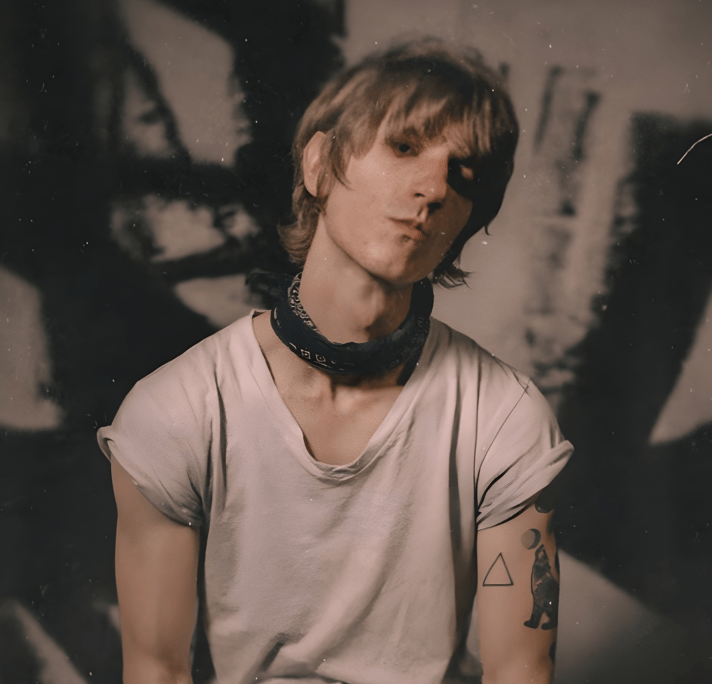
I want to tell about an unusual musician from Australia. Shu Lee is an independent singer, songwriter and composer. He was born in Malaysia but grew up in multicultural Western Sydney. In spirit he is Australian, and in his music one can hear the intertwining of Malaysian, Chinese, and Australian roots. For him, music is a language of trust and mutual understanding, a way to show that different traditions can sound in unison. His second album “Fusion Of Colours“, released in June, he literally created on his own: he wrote the lyrics and music, played all the parts, sang, recorded, mixed, designed the cover, and organized the release. And all of this – in a garage and with a budget of less than a thousand dollars. The result? A new genre and a whole philosophy, which he named MFDM – Multifaceted DIY Music. Before us is a rare case when music becomes an experiment on the edge of an anthropological gesture and an artistic manifesto.

And yet, better than any words about the concept of the album, the music itself speaks – 13 songs, living proof that no boundaries exist, neither cultural nor musical. Let me share my opinion on some tracks of the album. We begin with the first one – “I Am A Pyx“, where alternative rock intertwines with atmospheric synthesizers and rap, forming an introspective opening and emphasizing the genre color of the release. I found the track “Magpie On The Roof “quite interesting. In my view, its title contains the symbol of the whole album. The magpie here is a collector of shiny and diverse things, just like the author, gathering languages and genres into a single sound alloy. In mood, the track is closer to garage rock: lively, slightly rough, energetic, spiced with a light psychedelic shade. It expands the space and opens a brighter, more colorful page of the album.
It is in this context that the song “Dovijenya” appears – according to one version, the name comes from the Serbo-Croatian “goodbye”. Here one can hear a rupture between tradition and the urban modern sound environment. With incredible tenderness Shu Lee performs the song “Love Song To Lebanon.” The timbre of his voice and the structures clearly draw inspiration from Arabic music: melismatic vocals, heightened expressivity. The song becomes a musical letter: warm-bitter, personal and universal at the same time, it connects the emotions of an individual with the pain and hope of an entire culture. This very intonation also colors the track “We Should Get Married But We Can’t Afford It ” – an ironically sad commentary on today’s social realities. Sarcasm is already audible in the title: the desire to be together breaks against the coldness of economics. The music blends indie rock, punk audacity, rap phrasing and shades of Arabic melody. Such a constellation of genres gives the song protest energy – somewhat serious and at the same time slightly playful, sarcastic. Such a combination is extremely rare. In my opinion, this is truly unique – at least in my experience, I encounter this for the first time.
A characteristic example of cultural synthesis is the song “Kampung Halaman“, which in Malay means “native village.” Here rhythms from all over the world are gathered – a bit of Afrobeats, a pinch of Latin, and Asian colors. All this lies on a calm, minimalist foundation, so that the music flows freely and without overload. This is the only officially recorded song in which five languages sound: Malay, Tamil, Mandarin Chinese, English and Spanish, performed by an Australian artist with Malaysian roots. The finale of the album – “Bada Buru” – sounds like an ancient incantation. The song combines the Dharug language, once spoken by the Indigenous people of Western Sydney, and Mandarin Chinese – a reference to Shu Lee’s own roots. Such a duet is unique: before this, there had never been official releases where Dharug and Mandarin sounded together. The music pulses with primordial energy: the rhythm resembles a shamanic dance, the percussion – heartbeats and ancient drums. In the arrangement world music, experimental beats and ritual repetition intertwine, gradually immersing the listener in a meditative trance. “Bada Buru ” closes the story, taking us back to the origins – to a time when music was the language of community, and it ends the album powerfully and symbolically: a true cycle of cultures.

In the era of streaming algorithms, where the global is often reduced to the surface of playlists, Shu Lee offers a completely different experience. The album “Fusion Of Colours” is a bold gesture of an artist-enlightener and a cultural mediator. He creates a space where the Middle East and the Balkans, Latin America and Southeast Asia meet, and above all this sounds the language of global urban culture. This is not easy background music and not a trendy experiment for effect. This is a work that requires concentrated listening and readiness for unexpected contrasts. Ultimately, its uniqueness lies precisely in the fact that it reproduces our century, with its multi-layeredness and its anxious yet beautiful polyphony.
Published in partnership with SubmitHub




 Voxwave Magazine: Music, Culture, Interview, Fashion