
An amazing privilege – to have a form for the release of emotions and feelings. Not everyone is given it. Most people experience the same storms – jealousy, longing, delight, confusion, grief – alone with themselves. A feeling comes, stays for a while, and leaves unprocessed. However, creative individuals are somewhat lucky in this regard: an artist gets angry – and paints a picture. A poet goes through a breakup – and by morning he has a poem ready. A musician feels longing – and a melody or song appears. Grief, memory, searching often become the foundation for an entire statement.

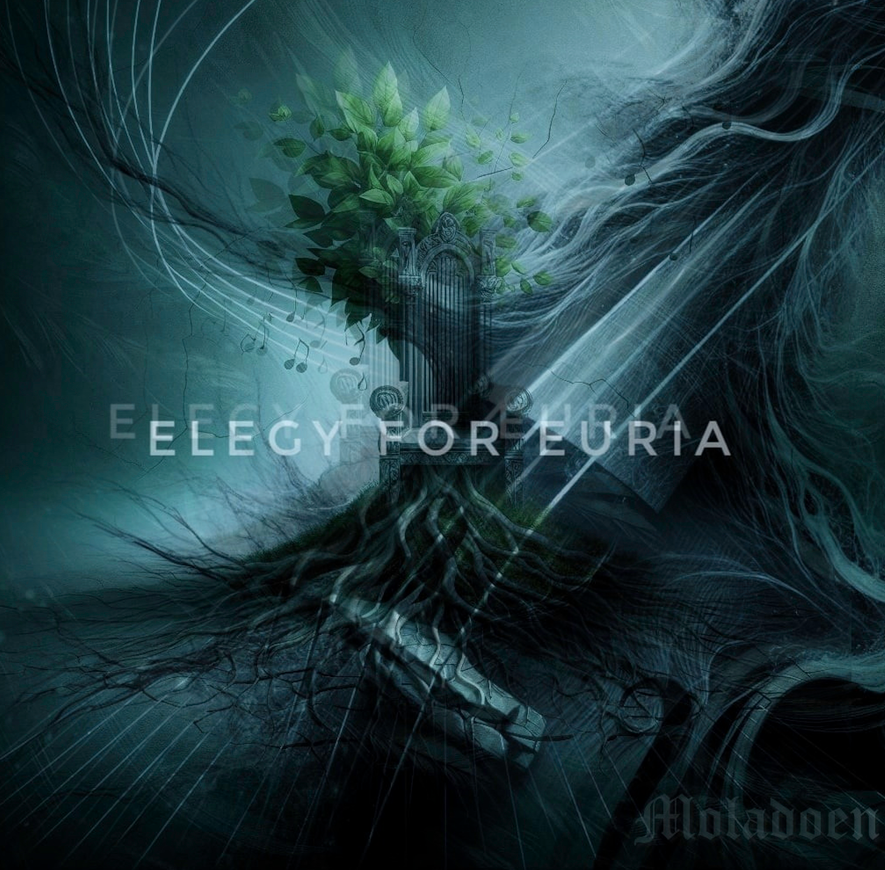
The EP “Elegy for Euria”, which will be discussed in this review, explores these serious themes. Its author and creator Moladoen works primarily in the field of contemporary neoclassicism, combining a modern atmosphere with expressive, narrative movement. The music passes through changing moods and ideas, flowing between softness and intensity without losing its integrity. The spectrum of melodies unfolds like a fragmented narrative leading to reflection and personal interpretation. Moladoen freely mixes acoustic and electronic sounds, builds compositions around mood and emotional intention. The result is narrative music that does not rely on strict genre boundaries.
The voyage of “Elegy for Euria”, just under a school lesson in length (35 minutes and 23 seconds), begins with the trembling and elevated track “The Marrow”. A fragile dialogue of piano and low strings. The music listens to the beating of a heart – uneven, wary, and alive. The piano sounds minimalistic, and the strings oscillate on the edge of longing and anger, the feelings becoming a concert for chamber violins. The entrance of the choir intensifies the drama. Most of the tempo decisions in the recording are logical and serve the author’s intention. The music is incredibly clear, conceptually structured, not lacking in artistic tension. The title track, “Elegy for Euria”, expands the palette – barely perceptible electronic resonances and a ghostly choir, sounding like memory, join the chamber intimacy. Here the idea of form appears – the track seems to draw the silhouette of grief, symmetrical and restrained, where repetition transitions into ritual. The music expresses a suppressed state – the author uses the dark tones of the instruments. Restraint and clarity, depth and measured pace themselves arrange into programmatism and concept. A composition rich in the colours of orchestral sound.
Thus “A Dance on the Edge of Oblivion” is the most dynamic place on the album, if one can speak of dynamics in the world of Moladoen at all. Electronic pulsations combine with strings, the breath of technology meets the classical. A circular movement arises – not of dance, but of an attempt to hold on to the edge of oblivion, as if grief had decided to take a few careful steps before freezing again. The choral episodes and string parts are particularly successful in the composition. Overall, “A Dance on the Edge of Oblivion” achieves the necessary level of dramatism through its lyrical, at moments, sound. “Evelyn” sounds unexpectedly fresh: in the waltzing melody the theme of memories becomes physical. The track is built around a soft repeating piano motif, over which string parts and choir gradually build up. It sounds like a collective memory that cannot be fully deciphered, the intensity of emotions does not dissipate but remains until the end.
The sorrowful violin introduction in “Velvet Measures” returns to a dense texture. Here Moladoen uses strings and electronics as equal partners: one instrument plays with a body, the other – with a ghost. Everything sounds like an inner monologue without words, where tension is held by the delay between notes. The choir changes its sound from thunderous forte to pianissimo. Throughout the composition one can hear the evolution of the intonational language, the artistic image, and the internal centre of gravity. The concluding “Blood Oath” brings the EP to a sacred finale. It begins with deep, pulsating bass harmonies, gradually dissolving into the choir and slow piano chords. The sound becomes dense, corporeal, like an oath given to oneself. Low frequencies, long decays, a lot of air between the sounds. The drum strikes – their sharp, bristling strokes – do not allow the tension to dissipate. The strings and choir appear together and continue in the same movement as the fugue that preceded them. Grief is not resolved – it becomes habitual.
The EP “Elegy for Euria” by Moladoen sounds captivating – this is precisely what makes the release impressive. Despite the seriousness of the theme, the cycle sounds bright, emotional, even passionate. The author wishes to catch an idea, to feel it, to imagine its image as emotionally flawless. Moladoen makes a choice in favour of rarity, difficulty, deliberate risk.
Published in partnership with SubmitHub







 Voxwave Magazine: Music, Culture, Interview, Fashion