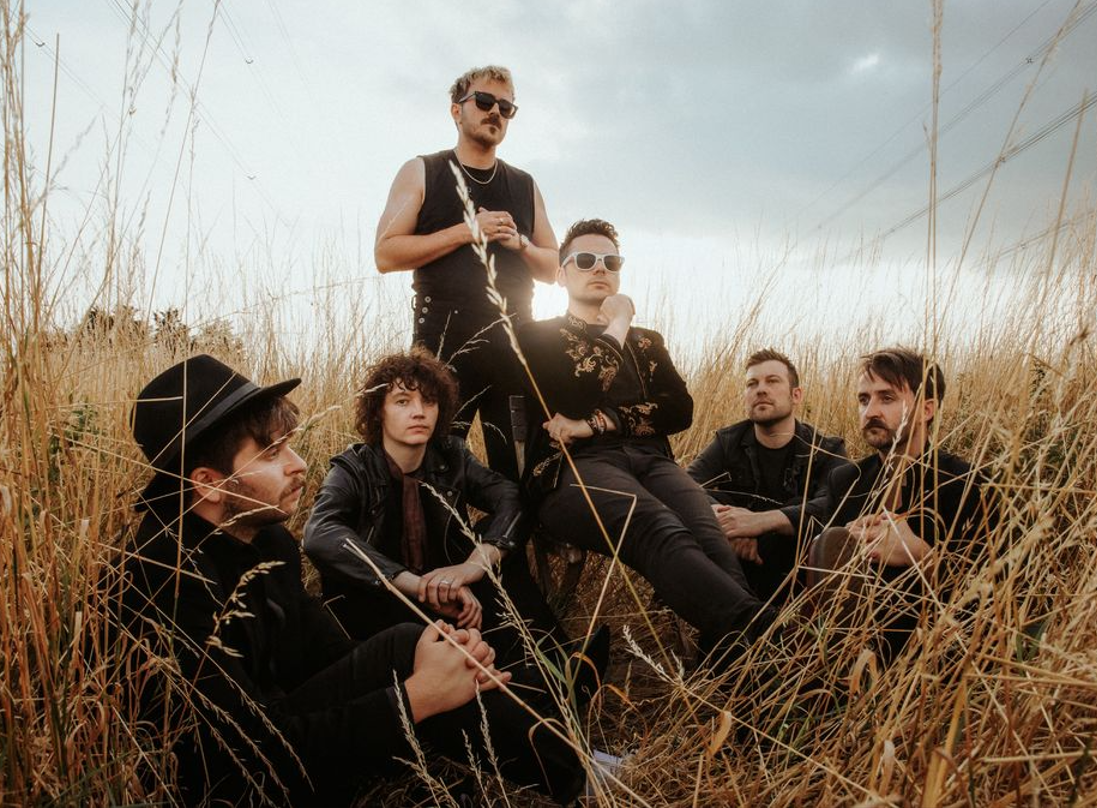
“A man must possess freedom, as wide as the prairies,” wrote Zane Grey. His westerns made the riders of the purple sage part of myth. But what is freedom if not an inner quality, independent of geographic coordinates? Sometimes, to feel the spirit of the wild frontier, one must be born not in Arizona, but among the harsh and poetic hills of Wales. On June 10, Welsh folk-rockers Rusty Shackle released their new single “Riders Of The Purple Sage.” Yes, we are talking about a band from Wales singing about the American frontier, about prairies, wind, horses, and endless sky. It would seem a paradox – but in fact there is no contradiction: freedom has no passport. Before speaking about meaning, one must speak about sound.
From the first seconds, the song behaves like a small story with its own dramaturgy. The first part – unsteady – is built on acoustic tension that keeps the listener in a state of anticipation. The sound breathes with a premonition of a storm, the guitar picking seems deceptively fragile, the vocal is sinuous, and the atmosphere is shrouded in fog. The second part explodes with carefree energy and dense, driving riffs. The song rapidly gains momentum, resembling a mad gallop toward the horizon, and reaches a most powerful, cathartic culmination.
The name “Purple sage” – sage, a plant of the American desert, yes. But in the single it works as a symbol: an inner space where battles are fought that no one sees. There are no cowboys here. There is something more interesting: an allegory of any person’s life. The text works with images of Western folklore and mythology. “The bottom of the rock has more to teach/ Than the top of the mountain, that I never could reach” – one of the key lines, sets the track’s inner support. Rusty Shackle carefully overturn the familiar logic of success, the fall becomes a point of growth. Maturity without pathos.
The theme of maturity runs through the entire second part – especially in the image of “steeds of plenty… tempered by age“. Freedom that comes later – after mistakes, losses, and attempts to understand who you really are.
The finale gathers all the lines into one wide straight line. “I’m running free as the wild wind blows” – a line expressing a state. Wind, plains, movement – the images become simpler, clarity appears. “This train is gonna take you home” – one of the most interesting details of the text. “Home” for Rusty Shackle is not a roof over one’s head. It is a return to one’s own “I,” the gaining of inner wholeness after long wanderings.
In the single “Riders Of The Purple Sage,” the Welsh musicians managed to express a complex allegory of the life path in the rhythms of an enthralling folk-rock western. Rusty Shackle found their freedom not in escaping difficulties, but in accepting them. And while the final call sounds – “Ride, ride, ride, ride with me” – it is impossible to deny oneself the pleasure of sharing this free gallop with them.