
There’s something amazing in how people romanticize space. We look at the stars and see love, although there – only vacuum and radiation. In 1984 Limahl sang about the neverending story, and this was not a metaphor, but a literal truth in how synthesizers can stretch time to a state of weightlessness. Forty years later someone is still trying to find love between planets, only now analog waves have become cleaner, and nostalgia – more self-aware. Among such musicians is Positronic, behind the pseudonym stands Michael McDannold, a guy from California who has been living music for the last 35-plus years. Starting in the band FOUNDATION in the late eighties, Michael eventually came to the format of complete freedom. In Positronic he does absolutely everything: from the first line of code to the final chord in the studio. A perfect example of what one talented person is capable of. His portfolio shines with an extensive discography, but today I will share my impressions about Positronic’s new album “Interstellar”, which was released on February 20, 2026.
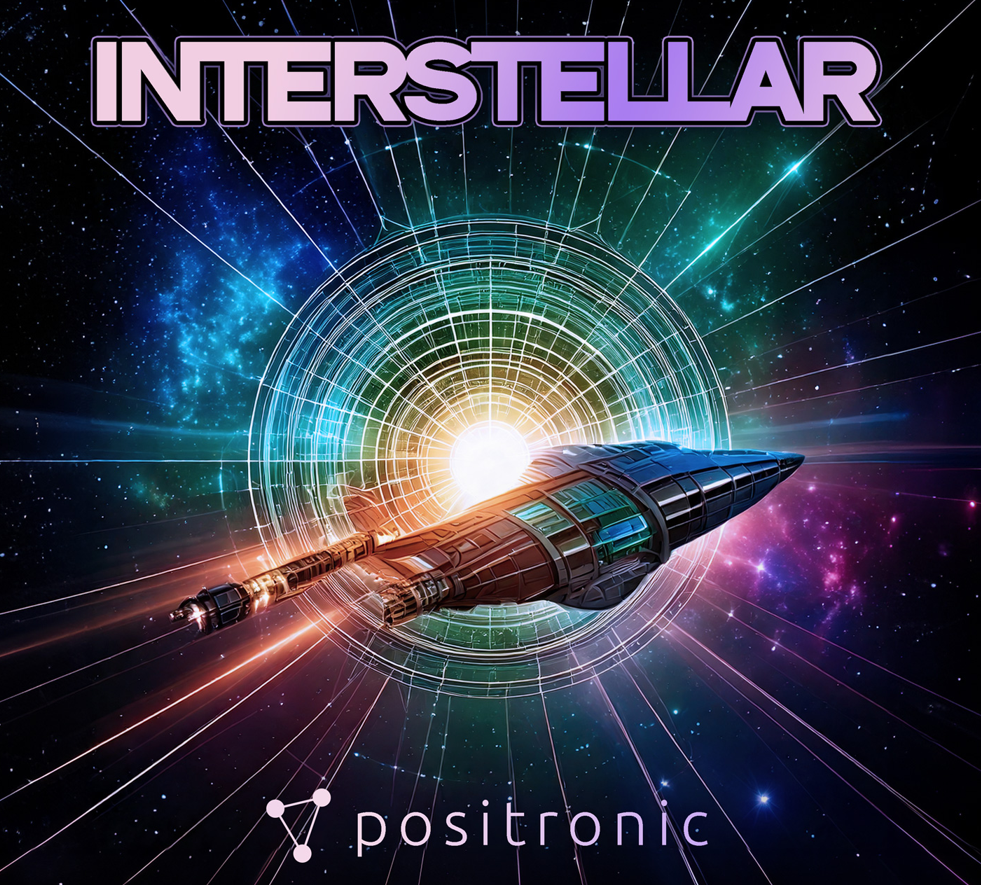
On “Interstellar” the author works with the same formula that once made M83 heroes of festival fields: synthpop as an emotional particle accelerator, where arpeggiated bass – is the pulse, and the reverb-tail stretches to the event horizon. Music for everyone: both for harsh fans who remember Robert Smith even without his signature nest on his head, and for “zoomers”, whose inner world consists 80% of “Stranger Things” aesthetics. In general, if neon flows in your veins, and in your heart – a drum machine, you’re at the right address. The album of 14 tracks definitely deserves a full analysis, but in this review I focus on key moments.
We start with “Cosmic Dreams” and “Gravity” – pure delight for synthpop fans! Listening to these tracks it seems as if someone pressed play on a cassette that had been lying in a box of cassettes since 1984. The first bars – Basildon sound: elastic bass lines from Moog, arpeggiated synthesizers that rise up the steps to the chorus, and the characteristic shimmer on high frequencies that Erasure, Pet Shop Boys and many others did – when they wanted to convey something elevated. Positronic works confidently with all elements, building melodic lines with architectural logic. Successful on the album I consider the cover “A Sky Full of Stars”. And in the context of the first tracks it sounds not as a random choice, but as a conscious statement. Coldplay have always been a pop group that was ashamed of its own accessibility. But as it seems to me, in his version Positronic returns the song to the roots of synthpop – a genre that is not afraid to be openly romantic. The melody acquires a new lightness, it is free and has no need to sound Important.
Quite romantically sounds “StrangeLove”. The track starts with a synthesizer takeoff – nobly and powerfully. The rhythm section sets the pulse, and the vocal adds emotions. Closer to the middle the sound becomes voluminous and “tube”: synthesizers envelop, and the melody fills with hope. In the finale the track turns into a real celebration – digital notes whirl in a dance completing on a high note under the clear beat of drums. “Starlight” the track opens mysteriously – through the fog of synthesizers breaks through a powerful pulse of bass. Against this background blooms a melody, and Michael’s vocal acquires special emotionality. While arpeggios scatter like sparks of starlight, the rhythm section confidently leads forward. This is music of triumph: when bass and drums work in unison, a powerful drive is created, which by the finale dissolves in a pacifying bright radiance. The opening chords of “Andromeda” create a cinematic sound based on pulsating bass lines and sharp synthesizer textures that transition from thoughtful introspection to cathartic liberation.
Another cover on the album that attracted my attention “The NeverEnding Story”, you’ll agree to re-sing a popular theme – is a task with an asterisk. For Limahl it was sparkling pop-magic, and for Positronic – serious, thought-out work. Noticeable is the reverent attitude toward the source, love for the material is felt and the desire to preserve something important. The closing track “Echoes Through Time” creates a space that one doesn’t want to leave. Michael returns the listener to the origins, where behind the impeccable electronic rhythm hides a living heartbeat, and in the timbre of the synthesizer – sincere human sadness. In the end, it is precisely the “machine” music that paradoxically sounds more honest and warmer than much else.
What makes “Interstellar” interesting? Surely many will think innovation, and I think fidelity to tone. When Depeche Mode recorded Some Great Reward, there was a strange mixture of cold electronics and indecent emotionality – synthesizers sounded like machines, but sang about things that machines cannot feel. Positronic understands this balance instinctively. The tracks on the album are assembled from the same legendary constructor – LinnDrum patterns, airy Roland Juno pads, Prophet-5 sequences. But this is not cosplay of the era. Michael understands the very physics of sound. And I think this is where true mastery lies.
Published in partnership with SubmitHub









 Voxwave Magazine: Music, Culture, Interview, Fashion