
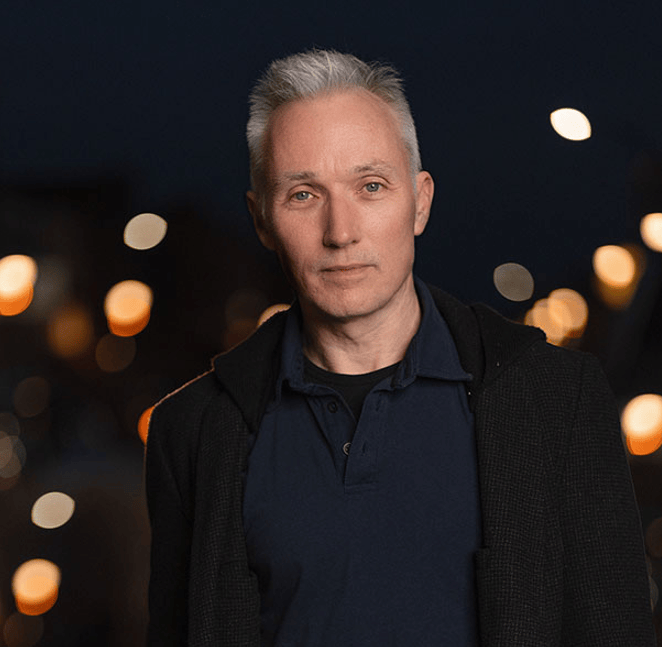
“Sometimes the only way to survive a loss is to create something,” Dren McDonald once admitted while working on his previous instrumental album, “Pterous.” At the time, that phrase was a personal confession from the composer: every piece on the album was dedicated to someone he had lost over the span of three years. Today, years later, that same idea has become the guiding principle behind the new album “Vox Pterous” – a record where the lonely voice of the guitar finally finds breath and words. McDonald is regarded as one of the most versatile and nuanced composers working in today’s interactive media space. His portfolio spans the intensity of Counter-Strike, the watercolor poetics of the indie game Gathering Sky (which earned him three Game Audio Network Guild Awards), and the cinematic atmosphere of projects like Stranger Things VR or the Venice Film Festival–honored film Perennials. Yet his solo work – from the “underwater Americana” of Oceanic to the acoustic explorations of The String Arcade – has always remained a space of utter sincerity. When work on the instrumental “Pterous” was finished, the composer realized the conversation wasn’t over. That’s how “Vox Pterous began” – a search for voices capable of breathing human life into the impressionistic sonic fabric of the previous album.

The starting point and main emotional impulse behind “Vox Pterous” was the track “Fading,” recorded with vocalist Sophia James, whom McDonald was introduced to by her grandfather, Chuck Wackerman – his old jazz teacher. In this track, the instrumental elegy first took on flesh: James’s fragile, intimate vocal dissolves into shimmering guitar textures, and fading gives way to a gentle transformation of memory. The success of this experiment led the author to spend long months searching for performers capable of completing the rest of the material. “Vox Pterous” unfolds with restraint, and the whole record can be compared to a novel in six chapters.
The album opens with “Anchors Up,” where Amelie Anna’s voice, repeating the same phrase, sounds like a guiding beacon over misty water. Simple, almost childlike lines set the meditative tone for the entire album and draw the listener into a voyage through hazy sorrow. Honestly, after such an opening, I was intrigued by what would come next. What comes next is “Resting of Light,” where Amelie Anna is joined by Karla Kihlstedt. The duet of two distinct vocal personalities creates the effect of an inner dialogue, as if two states of the same soul – calm and anxiety – have finally found common ground. I was deeply struck by the vocal lines here. They intertwine with the guitar’s polyphony, creating the illusion of sunlight refracting through deep water. Gradually, the album’s space expands – both geographically and emotionally.

This happens on the track “Aviator Eyes,” where McDonald sings alongside Paula Frazer and Girl Swallows Nightingale. Their voices weave together with an elegant, cinematic lightness, as if the song were filmed from a bird’s-eye view – living up to the winged origin of the whole project. My favorite on the album, one that struck me with its dark elegance, is “The Things He Could Bury.” It brings the listener back to more painful material. The dense guitar texture becomes slightly more contemplative, and here the voices of Amelie Anna and Girl Swallows Nightingale sound like two dimensions of the same memory: one closer to personal confession, the other to its ghostly reflection. The title itself struck me as ambiguous. What exactly ends up buried: things, memories, words, guilt – or the very possibility of saying goodbye? To me, it reads as a metaphor for parting, an attempt to gently let go of what can no longer be held onto.
The lyrical climax of the album is “She’s The Sky.” The voices of Lily Bloom and Daria Novo intertwine so tenderly that the song feels as though it were written for comfort – a trusting conversation between two people who understand each other without needing words. Its airiness is a reminder: light gradually fills the space that darkness leaves behind. The album closes with “Fading,” the very track that started the story of “Vox Pterous.” Sophia James‘s vocal is alive, vulnerable. Hearing this track in the context of the full album, rather than on its own, it sounded different to me – as if I finally understood, for the first time, why the five tracks before it were necessary. Returning to the past with a new inflection – that is the central method of “Vox Pterous.”

McDonald produced, recorded, and mixed the album entirely on his own, keeping full control over its inner acoustics. Additional mixing on two tracks was done by Bryan Jerden, stereo mastering by Piper Payne, and the artwork was created by Kristin McTernan. Dren McDonald writes music for the attentive listener – someone willing to let the melody unfold slowly. As the composer himself once said: “sometimes the only way to survive a loss is to create something.” “Vox Pterous“ is proof that out of that “something,” a genuine work of art can emerge.
Published in partnership with SubmitHub





 Voxwave Magazine: Music, Culture, Interview, Fashion