When I wrote about the first Outsideness album, “…From What?”, I was mostly occupied with the question of how this alliance came to be: Freidrich$ with his inside-out R&B and Azalias with her languid voice. Back then, it was important for me to understand the mechanics-to explain to myself and to the reader why the collaboration works. I found the answer, but I felt that it was incomplete. Too much remained outside the brackets. And now the duo returns-and along with them, I return to the conversation. Only the question is different now. “…Then After?” asks not “from where,” but what happens after the alliance has already taken place and proven its right to exist. And to me, this question is more interesting than the first one.

This shift defines everything I hear on the album. If the debut was feeling out the grammar of the project’s language, the second album is already freely managing it-breaking the syntax, allowing itself phrases on the verge of absurdity. The skeletal R&B and outsider aesthetics are in place, but they sound more spacious, more melodic, and far less concerned with staying within the boundaries of a single genre. Listening to “…Then After?” is a trick activity: as soon as I decided that I was dealing with R&B, the album turned into a rock record; just as I prepared for acoustic-it dragged me into UK garage or prickly drum and bass, sometimes within the boundaries of a single song. At some point, I stopped classifying and simply listened to where it was carrying me. Outsideness treats genres like clay. The question here is not “what kind of track is this,” but “what else is it capable of turning into.”
This instability is walled into the architecture of the album. An acoustic guitar gives way to electronic percussion in the middle of a phrase; intimate vocals suddenly find themselves surrounded by a symphonic arrangement; a song becomes unrecognizable by the middle. And the voice of Azalias does not let the production experiments of Freidrich$ fall apart. “…Then After?” is more ambitious and at the same time more direct than its predecessor. The arrangements have grown, the production work has become more complex, but the rough edges remained. What turned out was not a reinvention of Outsideness, but an expansion of what had already been found. There is rock on the album, there is dance music-but dancing to it in the usual sense, for me personally, is hard. Out of the ten tracks, I will dwell on seven-those where I myself stopped while listening, rewinding back.
The first track “Alright” opens the conversation deceptively calmly-as if the duo is apologizing in advance for everything that will happen next. Starting as a familiar, restrained R&B sketch, the track sheds its mask: the bare vocals of Azalias glide over a rough sampled framework, clearly demonstrating how monumentality emerges from intimacy. The building scale breaches the boundaries of genres in the next song, “Freedom”-here, Outsideness seem to stop controlling themselves. Built on ambient and chillout textures, the song dissolves the rhythm: the voices of Freidrich$ and Azalias envelop the melody, filling the space with themselves. After the dense monumentality of “Alright”, it is a moment where the duo sounds as one whole.
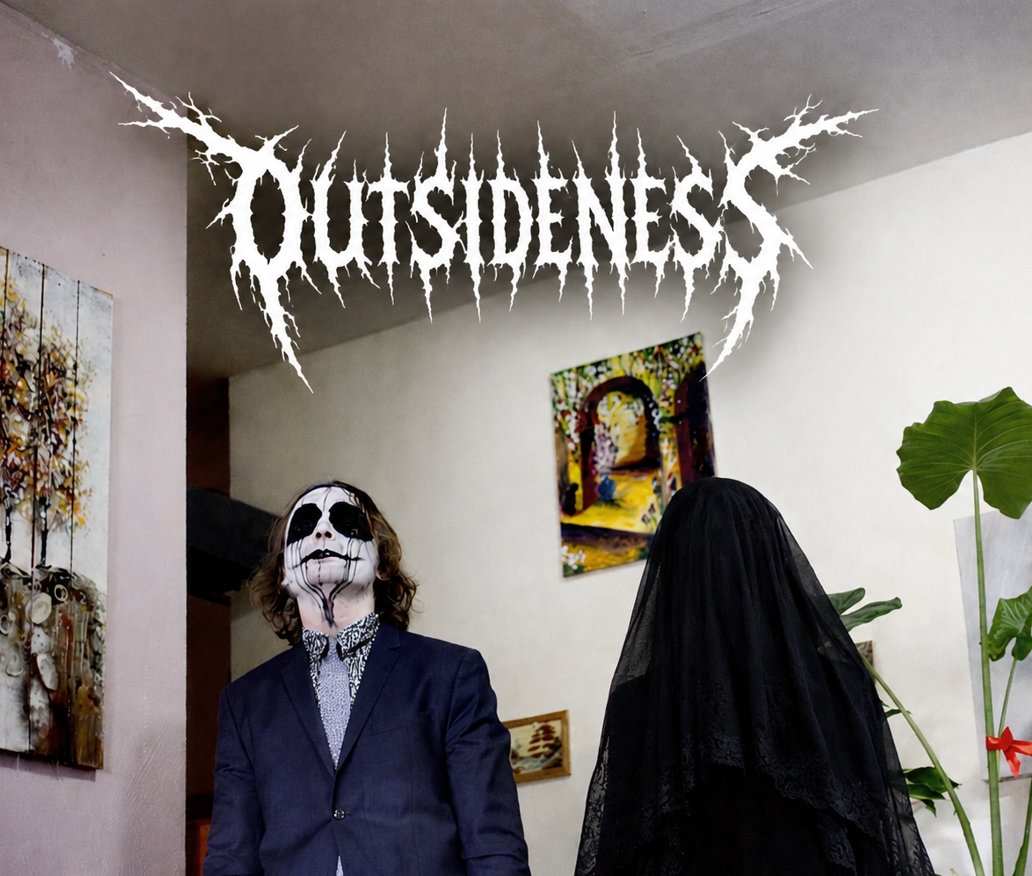
However, freedom does not remain boundless for long. Already in “Container”, the album, as it were, pulls itself back, ironically playing with its own name: a song about an attempt to hold something inside a form that is knowingly cramped. The sound fluctuates between an anxious states of meditation and a cathartic release. The arrangement is bursting at the seams, while the vocals hold onto the melody like a last stable landmark-the instability that moved “Freedom” turns into resistance here. The struggle for form is replaced by the sensual and hypnotizing “Got Me”, built on an intimate atmosphere, a focused rhythm, and emotionality. The melody here is without traps-and that is precisely why it catches you off guard. A transition from pure space to emotional contact, grounding, and a focus on feelings.
Thereby, in the track “La Jetée”, the author again goes towards fragmentation-a freeze-frame track, referring to cinema by its very title. The sound gets stuck between frames: fragments surface and disappear, as if edited by association. Out of the discontinuity, the album enters fluidity. “Water” is a fluid thing in the literal sense: the arrangement flows from one state to another without sharp seams, and the vocals of Azalias are closest to a conversational intonation, as if the edit cuts of the previous track have finally smoothed out. The final track “Hold” closes the album with a therapeutic gesture-music about a focal point, a pause, and the ability to stay in the moment. The song acts as a connecting link between the conceptual enclosure of “Container” and the complete liberation of “Freedom”, offering the listener a moment of conscious pause and acceptance.
It was interesting for me to listen to the new work by Outsideness. “…Then After?” is the sound of my own discovery: how much, it turns out, can be said in a language that only yesterday seemed like merely a beautiful coincidence. Now the album answers: strangeness is not a side effect of the collaboration between Freidrich$ and Azalias, but its method. And the ellipsis in the title is a promise that after “after,” something else will follow.
Published in partnership with SubmitHub