Jack Quigley makes me want to compare him to a horticulturalist who patiently and persistently works on cultivating new varieties, say, of apples, distinguished from those that already exist by their size, colour, flavour or, for example, exceptional frost resistance. This perhaps somewhat extravagant comparison came to me in connection with the story behind the creation of the release I am about to tell you about.

“Upstream Vol 1” is the debut album by independent composer Jack Quigley, based in Naarm (Melbourne, Australia), and the first part of the ambitious “Upstream Trilogy”. Jack defines the style of his project as Anarcho-Pop – music that becomes possible only when uncompromising collaboration and horizontal co-creation take centre stage. From 2020 to 2023, Quigley travelled through the central deserts of Australia and visited Cairo, Barcelona, Palermo, Beirut, Djibouti and Addis Ababa. As a result, the trilogy spans four continents: 27 tracks, 55 musicians, 12 studios and eight languages. The album was produced by Stefano Pizzolato, while the mastering in Melbourne was handled by Grammy-nominated sound engineer Nick Herrera. “Upstream Vol 1” features numerous international and local collaborations, bringing together artists with different musical and cultural backgrounds.
Now let us see what this remarkable sonic garden, “Upstream Vol 1”, is like.
The album opens with “Coming Into Land”: from the barely audible rustle of a needle on a vinyl turntable, a smooth, soothing bass gradually emerges. It is joined by a gliding synthesizer and the confident, measured stride of the drums. The final touch comes from the vocals, which gently but decisively bring the listener down onto the earthly surface of this release, marking the beginning of a long journey. After landing, we move on to “Dhunkasho” – a track where soft, flowing vocals establish a romantic mood, carried through the synthesizer parts, while the electronic drums move to the rhythm of a dance. In Somali, “Dhunkasho” means “kiss”. Qare The Mask, an artist from Brisbane, gives the track a smooth vocal surface beneath which disco, psychedelic textures and Afrofuturist imagery collide. The lyrics were written by Nadia Faragaab and grew out of an adventurous childhood game: lovers kiss on a bridge above a motorway until the first passing car honks at them from below.
The festive half-light dissolves into the cinematic bustle of “Cairo Streets”, where the hum of the Egyptian capital flows into an Eastern melody. A dense bassline, velvety saxophone and supple percussion revolve in the rhythm of an Eastern dance. Building tension, the composition weaves together the teeming life of Cairo’s streets and a delicate instrumental arrangement.
From Cairo, we are carried away to Addis Ababa – the focus track “Addis Ababa”, recorded with the participation of Kamuzu Kassa and Nina Girma, two leading figures in contemporary Ethiopian music. In Amharic, “Addis Ababa” means “new flower”, and the song grew out of an idea by Quigley, which Nina Girma developed into lyrics, transforming the image into a sonic journey recorded at Shakura Studio in Addis Ababa. I think the gardener metaphor acquires a literal resonance here.
From the flowering streets of the Ethiopian capital, we set sail. “Music is everything, it is my life” – this is the meaning conveyed by the opening dialogue of the track “Sailing”. The taut, pulsating rhythm of the bass, the ringing pattern of the drums, expressive saxophone passages, vocal harmonies and recitative intertwine into a single musical canvas breathing with energy. The theme of freedom and passion is vividly expressed in the track “Andalucia.” The line “Dime el nombre de la flor de la revolución” is the emotional centre of the song. A flamenco motif blends, with jazz inflections. The dry crisp cajón and improvisational saxophone give the sound a southern character. The harmonious duet of male vocals shows the fervour and pride of Andalusia with great precision and the flamenco motif shines through every note.
After the passion of the south, the release moves into a contemplative, meditative mood. In “Riverside Woman”, the morning chirping of birds gradually dissolves into tender synthesizers, giving way to a smooth melody with a pulsating bassline and elongated, enveloping vocals. “True Name” unfolds in the same rhythm as “Riverside Woman”: its island melody transports us to scorching beaches, while a reggae motif calls us to move in time, and before long, we find ourselves swaying involuntarily like a palm tree in a tropical wind. “Skinny Lips” brings the programme to a close – a short farewell composition with accelerated drums and sharp guitars, as if someone had waved one last time and disappeared beyond the horizon.
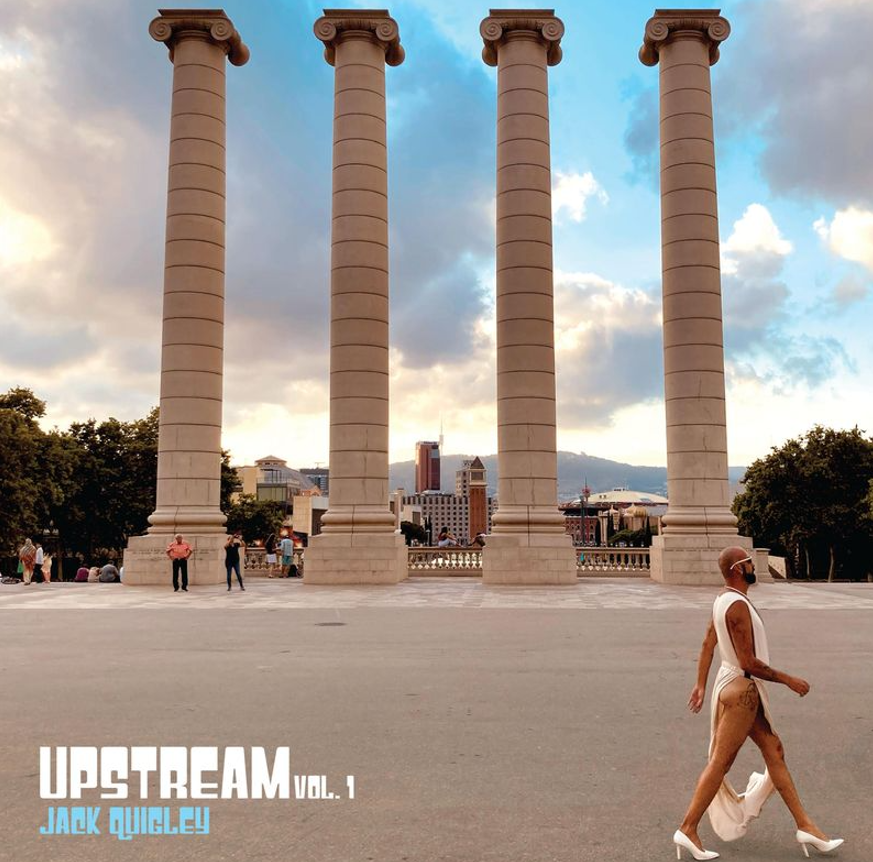
“Upstream Vol 1” is a sonic map of a journey in which every track is a stop in a new city, a new encounter, a new language. Jack Quigley truly works like a horticulturalist: he crossbreeds cultures, genres and voices to cultivate new varieties of music – more resilient and more diverse. I have introduced you to the first volume of the trilogy; all that remains is to wonder what other flowers will bloom in the next chapters of this ambitious project.
Published in partnership with SubmitHub