If it took a falling apple to get Newton thinking about gravity, then Austyn Moffat needed a synth and his own head. According to the story, the apple didn’t actually hit Newton in the head; he just watched it fall from a branch and started thinking about attraction. Moffat took a much more direct route to discovery in that he put his head down on the Moog Muse and accidentally played two notes. At that very moment it appears he discovered not a law of physics but his own musical style.

Prior to that he’d actually been hiding in music as well – trying on other people’s genres like other people’s costumes and wondering what a “proper” artist was. Post diagnosis the question was a different one. “I wanted to create a project in which I could find my own sound and my own identity,” he says. That’s how Silent Collision came about – a name which on the surface is quite simple but which actually contains a very real shift – two things collide and each one alters the other’s path. Moffat pushed the computer to one side and turned to the synthesiser an object you can actually lean on and in fact, you can bang your head against. “Right at the beginning nothing would work at all and I thought ‘Right, music just isn’t for me’.” Then he started banging his head against the keys. At some stage he lowered his head down onto the keys and two notes ended up being pressed under it. There was a jolt of electricity through his whole body and he had no idea what the hell it was, but he liked it.
From those two notes came the very first piece to be released under the name silent collision: “Storms Within Stillness”. The whole project is encapsulated in that title really: a storm within stillness, a tension beneath the surface. It’s also a nod to his home state of Oklahoma where people are used to looking at stormy skies. Moffat describes his approach in exactly the same terms: “It’s like floating in the air without a parachute, you just fall and hope you can transition into a glide. silent collision is about feeling not thought.” He’s got the most incredible ear for sound and inspiration to be found in the most mundane of places. The hum of the ventilation system, the lawnmower in the back yard, the shower going. He doesn’t hide the rough edges at all, they’re the very pulse of it. What he writes in a week he takes to therapy and they listen to it together in order to work out what it’s all about. “Sometimes it feels as if the songs are writing themselves.”

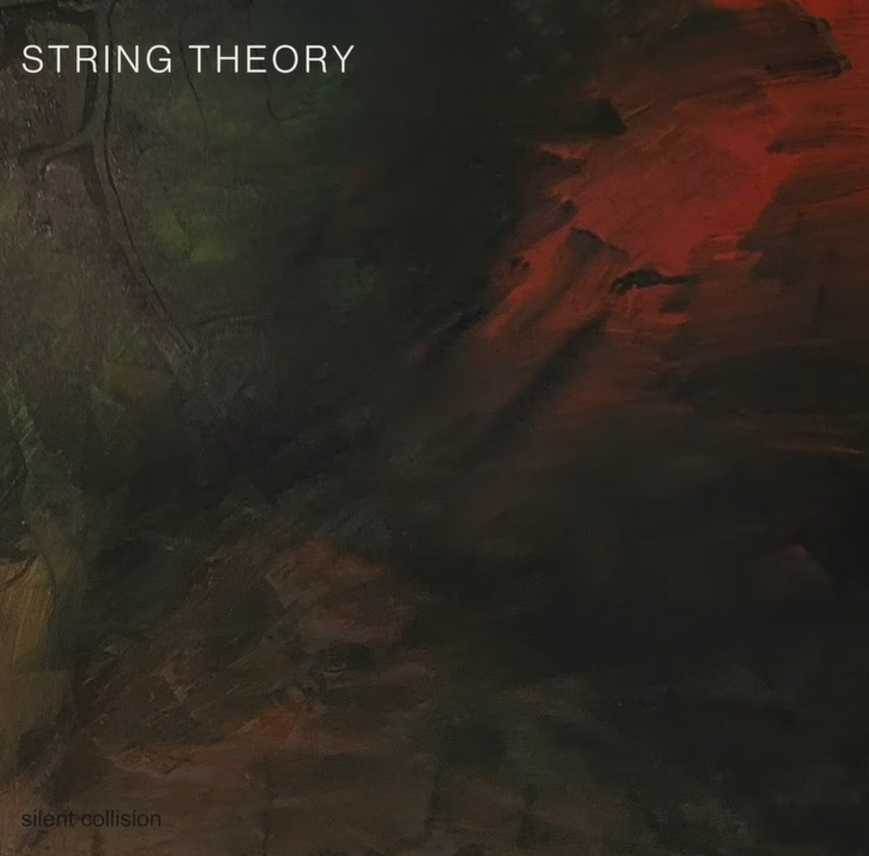
All of this culminated in the “String Theory” album, released on 6th November. The author saw it as the soundtrack to a film about his own life which never existed. It’s cinematic ambient/post-rock with the sound of whispers of guitar and airy synths painting pictures of space, time and the human condition. The album opens with “Approaching the Precipice” which is a musical holding of the breath. A slowly building hum and wavering guitar reverberations give the impression of being at the very edge of a high cliff, just before you take that step into the unknown. That’s the gateway into the world of silent collision’s music. On “Everything, All at Once” I actually held my breath. The layers are so thick you lose the ability to tell where the guitar ends and the synths begin. For me a “wall of sound” is normally a very positive thing, but here it’s quite literally a wall. That’s precisely the uncertainty that silent collision is talking about, the day when everything happens at once and you’re all on your own.
Then the sound pulls back for a moment. In “Vestige” there’s an echo of the past: sparse acoustic reverberations and a melancholy keyboard, the ghost of something long past left in the memory. But “Fragile Horizons” is a very transparent panorama. There are these thin, fragile synth textures right along the horizon, just ready to scatter at the merest movement of air. There is hope in it, but it’s hope that’s just within reach and it’s afraid of its own light. “Impermanence” takes up the theme of fragility and turns it into movement. The smooth shifting of violin chords with no real boundaries is a very physical manifestation of fluidity indeed. “It sounds banal really, because that’s the point really. It’s only banal because it’s true. Things are so much more enjoyable because they’re going to end one day,” says the musician. In his music that idea is like a light that becomes more and more visible as the day goes on.
And then the sky finally opens. “The Sky Opened for Me” is a moment of real revelation. It starts out quite quietly with a guitar arpeggio and then builds right up to a massive, cloud splitting kind of explosion. The artist says the track is all about the way the world became so much more beautiful when he learned to accept himself, to accept the sounds he made and to realise that he could in fact write music that was quite unlike anyone else’s. The album closes with “The Warm Embrace of the Sun” which is just a very soft, very dawn-like warmth. It’s all enveloping, all warming harmonies and a very smooth resonance leading into a state of complete peace and tranquility. It’s an ending where you just feel like you’ve finally landed after a long fall.
I’m not sure “String Theory” is quite the right sort of album for the subway or the gym really. It’s an album that needs headphones and an evening. There are certainly more inventive ambient and post-rock records out there and you can pretty much work out the trajectory from the precipice to the dawn, but that’s precisely what I find so compelling about it. It’s the sound of someone who’s spent a long time falling and who has finally learned to glide. The silent collision spent years in the position of trying on other people’s costumes and here you can actually hear him finally getting into his own. A bit awkwardly perhaps, but with a sense of relief. By the end of it I was sitting there quietly with my now quite cold tea, not in any rush to get anywhere.
Published in partnership with SubmitHub