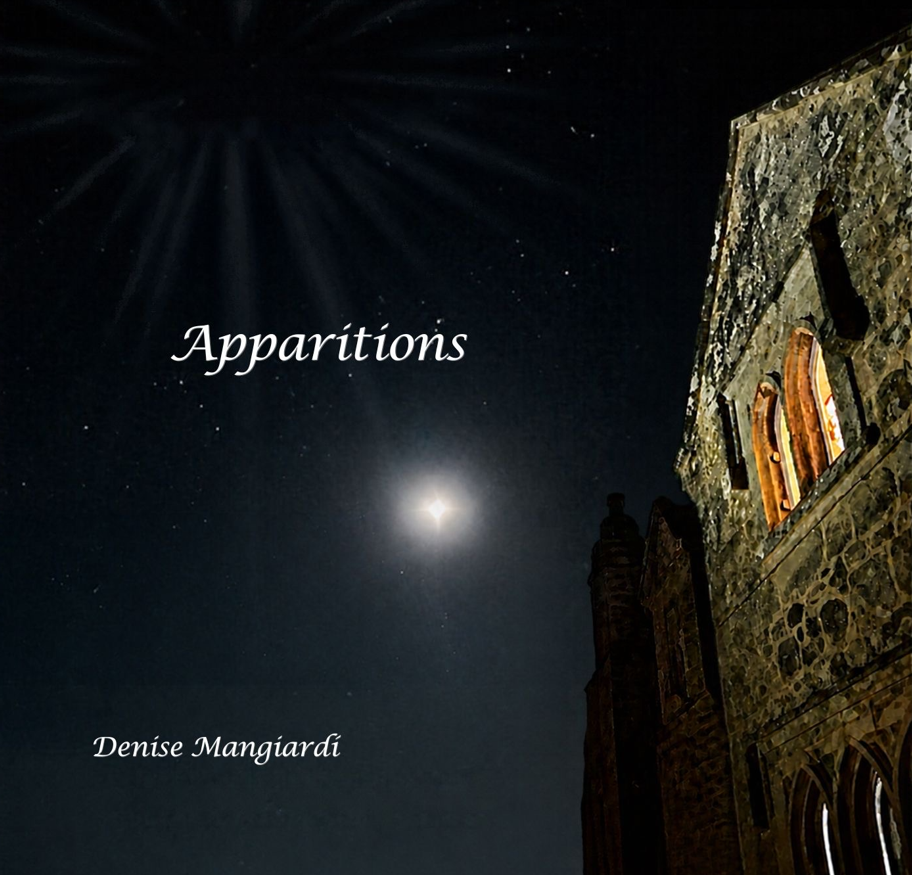
Denise Mangiardi is a pianist, vocalist, composer, and arranger whose path has taken her from New York jazz clubs to concert halls and orchestral studios around the world. Her ninth album, “Apparitions”, created with producer Chris Hyson, is the culmination of years of artistic exploration and, at the same time, the beginning of a new creative chapter. The record brings together original songs, jazz improvisation, piano, orchestral arrangements, and a cinematic sense of form.In this candid and light-hearted interview, Denis e talks about fateful encounters with jazz legends, what it is like to combine classical piano with Chris Hyson’s contemporary production experiments, and why, after sixty, life in the arts is only gaining momentum.

Hello, Denise! Nice to meet you and thank you for taking the time to speak with us. Your impressive musical biography spans New York, jazz clubs, academic education, orchestral projects, and London. But when did you first realize that music is your life’s work, and what fascinated you the most at the very beginning: the piano, composing, or telling stories through sounds?
Hello, Nice to meet you as well and thank you for this interview.
I started out singing at a very early age. The teachers used to take me to sing in front of the classrooms when I was about 7. I absolutely loved cinema and was greatly influenced by cinema .
Probably the most inspiring thing for me too was the radio. I grew up in New York so we had a lot of radio and it was often in every style you could imagine. They used to have late night hosts and I used to stay awake listening to them tell stories about the musicians and the tales behind the songs. I must say though that everything changed when my mother brought home a very old upright piano that she got from a barn in the Adirondacks in New York. I could not stay away from the piano after that. I was 10 years old when I absolutely knew what I wanted to do with my life.
You started writing and performing your own music at age 14 on the stage of The Bitter End in New York, studied at Berklee College of Music, and earned three master’s degrees in London and Sofia, while the legendary Gil Evans advised you never to quit music. Which of these played the main role in your formation, and how much does today’s musical signature of Denise Mangiardi differ from that young girl on the New York stage?
I would say that my first education and scholarship as a piano major and Marymount college in Tarrytown , New York. I was fortunate to have a really great piano teacher then and that really changed the way I saw things, because up until that age, I was writing my own songs. Somehow , playing Debussy and Bach changed the way I thought about music in general.
My mind began to expand , especially my composing. I left Marymount to go to Berklee, because I struggled with reading. In those days , dyslexia was not really a thing people talked about. I only felt less then, as I was unable to understand why I struggled with reading. So I quit Marymount, very proud, and went to Berklee where I came into the bigger world of performing and jazz. It was like walking into a completely new world. It was amazing. I would say those two experiences were really big for me regarding my formation in the musical world.
You perform in several roles simultaneously – as a pianist, composer, arranger, and producer, and you move freely between jazz, classical, and orchestral music. Do internal disagreements ever arise between these roles? Which of them ultimately gains the upper hand when creating a track, and why is it so important for you to remain outside of genre boundaries?
That is a really great question. I would say that ultimately the only thing that matters in the end , is what I want to hear. So the music wins in the end, every time. The great thing about jazz is that is ignores traditional boundaries. So that gives license to ignore what anyone or any style demands. However, I respect all of these disciplines and I am grateful, because of all my experience playing and performing and recording, I have gained an understanding of how to get the best out of each situation. I believe that is so important to create music that communicates with others. My biggest issue is playing and singing because I sing when I improvise and that is a very bad habit. I would say also , for the rest of the world, I have had issues with classical composers, taking me seriously. That is also something that I ultimately ignored because the music is the only thing that really mattered.
4. You have collaborated with Jason Rebello, Jerry Bergonzi, Jay Anderson, and received support from Ellis Larkins; your works have been performed by Orchestra Toronto, and the composition “Songs of the Rainforest” was dedicated to Ayrton Senna. What do such alliances give to a musician, and whose guidance had the strongest impact on your attitude toward creativity?
I have been greatly honoured to have worked with these people. I think the most amazing thing is that I was always learning. I took lessons from Jason, and he taught me so much about slowing down. It is something that I never actually ever thought about. Jerry Bergonzi, taught me so much about harmony. Ellis Larkins is without a doubt , one of the most powerful people I have ever worked with. Wow, the harmonies he played.! That had an huge impact on my musical journey. It wasn’t just his harmonies, it was the way he played jazz with a concert pianist skill and played way behind the beat. He took me on , and used to call me his God daughter. I loved him. I dedicated my first album “Fine Tuning” to Ellis. It is not easy to say which one had the strongest, but I would say that all of them knew that I wanted to learn, so I always had a huge appreciation and respect for these incredible musiicans. But most of all, they took the time to help me in so many beautiful ways. Jerry is also such an amazing individual. These musicians have seen how I have developed and seen how I always kept trying to create good music. In the end, I think that is what all musicians want. They want to be supported.

Your album ‘On The Brink’, which combined jazz, classical music, and large-scale orchestrations, won critical acclaim and received high praise from Chick Corea and Al Schmitt. Today, do you look at it as a completely finished chapter, or as a foundation from whose ideas your new album grew?
Actually Al Schmitt loved and commented on my album ‘Brown Book” which is also orchestral. Chick reviewed my album “Skylark”. I am far from unfinished.
I was thinking the other day, I know that I am not Beethoven, but many people wonder at my enthusiasm to continue , but do you think that anyone like Beethoven would quit because he hit the age 65?? I doubt it. The fact is this is true of all true musicians. Music is our life and why quit? I may not be as pretty as I was twenty years ago, but that is not the thing that matters.
Now let’s talk about your new, ninth album, ‘Apparitions’. You call it a kind of summation of everything you have accumulated over the years of your musical career. The title itself sounds mysterious and a bit cinematic. How was its concept born, what story did you put into it, and why did you settle specifically on the title ‘Apparitions’?
I have music that comes to me often in the middle of the night. In fact it can be driving a car, or taking a walk. Each time, I sing what I hear in my mobile. Thank god for a mobile phone.
So each time they come, I sort of obey them. I finish what I hear. Ultimately, I complete a process that comes to me like an apparition. I would say , it is a summation because I really don’t care anymore if it is not pure jazz, or pure classical, or a folk song or a bass nova. I have let go of all of these concerns. So that would be the reason . And yes, it is cinematic because I have always thought about music in a cinematic way..
A key figure in the work on ‘Apparitions’ was the London-based producer Chris Hyson. What changed in your sound thanks to this collaboration, and how easy was it for you to experiment with a producer who brings his own vision to your already established authorial signature?
I have never before worked with a co-producer. During the last 3 albums, I found that the amount of work, regarding getting the musicians, organising the rehearsals, organising the recording, doing the orchestration and playing a role as musical director in the studio when I should have been paying attention to the part of music I had to play.
I realised a few years ago, it is too much. Also, I found that I was bored with my own music and I knew I wanted to work with someone , but I could not find anyone that I felt I could work with. Chis is so cool, the way he thinks, He is what I would call a very brave thinker, so he does what he hears, and I absolutely love that.
Of course, synths and these types of soundscapes, is not my thing but he is wonderful and he added so many great kinds of ideas to the music. He really brought it to life and made it even more approachable. So working with him brought the best of us out musically.
He is great at bringing out things that are already there but with a different sound. He is very talented and I am thrilled that we worked together so well.

Recording three compositions with the Royal Scottish National Orchestra is a serious experience even for a seasoned musician. What did you feel when hearing your works performed by them, and how did this work fundamentally differ from recording a jazz album? And why was “Thursday’s Child” chosen as the lead single?
I cannot even begin to say how incredible it is to hear your music being performed in a setting like the RSNO. They are top notch and the sound in the studio is insane. I was so excited and so happy. It is one of the most powerful experiences in the world to hear your music performed that way.
I like very much to incorporate jazz with classical. So I treated the arrangements like a back drop over a jazz ensemble. It’s a very satisfying combination. I am a great lover of Claus Ogerman, Johnny Mandel , Gil Evans and Miles, so I have been very influenced by the way in which they brought the two worlds together.
Thusday’s Child:
I came up with a melody I heard one night, and I wrote it out but I had not finished the song by the time Chris came to help me get started with laying down some of the piano tracks.
The night before I recorded the song , I heard a particular line over and over, but then I came up with a completely different melody on the day of recording to use like a guide tone line. In other words, I wasn’t at all ready to record the song. So Chris asked me, what do you want to call this song. It was a Thursday so I said, Thursday song.
The following week, I wrote the lyrics and came up with a completely different melody and ditched the 2nd one and dedicated the song to my two girls. One is a geologist in Australia and the other is a singer-songwriter based in Austin, who is always on the road. I decided after I finished the lyrics to title the song, “Thursday’s Child”. After naming it , I looked up the meaning of a Thursday Child and realised it was from an english nursery rhyme book for children. The Monday child, Thursday child, Wednesday Child ect.
The Thursday’s Child is wild and free and open minded. It was a complete coincidence. Love these kinds of things.
A ninth album is a great occasion to assess past experience and look into the future. What do you allow yourself in creativity today that you wouldn’t have dared to do 10–20 years ago? And can ‘Apparitions’ be called the beginning of a fundamentally new chapter, rather than just a summation of previous years?
I would say that this is a beginning of a new chapter. I see myself doing more large scale musical works and film scoring. I am not so worried any more about what people think. When I was young and even until maybe ten years ago, I worried a lot about that . I am also a lot braver as a woman because, believe me, it has not been easy, I never like to bring things like that up, but I can say today, I am no longer afraid to speak out , not just about the music, but about what I actually think.
Managing the studio Alices Loft Music, dividing your life between London and the Isle of Wight, and preparing the album launch at PizzaExpress Live, do you still have time to just listen to music without professional analysis? And finally, what unfulfilled musical experiment or dream do you still think about?
I can always listen driving the car. That is a wonderful environment for listening. One of my favourite pass times. I love all kinds of music, Folk , country , blues , as well as pop music. Anything that is genuine. I like to listen to albums in the morning. My plants love it too.