Thelonious Monk once said “the piano ain’t got no wrong notes”. That sounds rather bold until you understand what he meant. In jazz you don’t need to be perfectly in tune, you just need to be able to hear where a random note is taking you and not be frightened of the turn. To me Sven WAIDA’s “WAIDA with JAZZ” is very much a band that operates on that principle. This isn’t a finished album with a final chord at all, it’s a musical stream that’s still growing. Since 2026 Sven has been adding a new piece to it roughly once a week. The title is actually a bit of a language game: WAIDA is “weiter mit dem Jazz” (onward with jazz). For someone who once left their whole life behind to become a musician it sounds more like a bit of a motto than a joke.

Almost all the pieces were recorded in one continuous take. That’s the jazz way of doing it really, to preserve the living breath of the music. Improv doesn’t work with endless corrections, it just stops being improv. There are only two exceptions: “A Thousand Miles Away From Me” and “Love Is Certain – LIVE”. All the rest was on a 1881 Grotrian-Steinweg concert grand piano (serial no. 4517). It has the character of an old instrument, it has a very particular timbre and a very muted memory of it’s own. It’s probably on pianos like that that jazz first learned to speak. Sven himself has said he would have preferred a new concert grand, but the circumstances of the recording were such that it was the other way around. Possibly for the better really. The old Grotrian-Steinweg is the very warmth that you can’t get from a new instrument.
The 433hz tuning also contributes to the character of the recording. The difference from the standard 440hz is minimal (just 7hz) but to my ear the piano does sound a little lower, a little softer, a little less insistent. Of course that’s all very subjective, it really depends on the instrument, the recording and the way you’re listening to it at the time. It does seem to me that the extra sheen is gone and there’s more air between the notes. The harmonic language doesn’t aim to be convenient at all: extended chords, all sorts of surprising progressions, major sevenths with altered ninths. Sven wasn’t out to ‘break’ classical jazz. Those decisions emerged from the context of live improvisation and the mood of the moment. It only subsequently became apparent that on paper they are quite bold in the classical harmonic sense.
“WAIDA with JAZZ” is all about love of jazz and love of human creativity in general. It’s a conversation about how to create, how to live, how to protect and how to preserve those connections that are worth it and about the hope that music can in some way make someone’s life a little bit better. The LP contains 20 tracks and quite a few of them are very long so I’ll be talking about the ones that had the most impact on me.

“Liebe ist Gewiss (Lieder für Liebende)” kicks the album off very smoothly and very deliberately. It’s an acoustic song, piano, live version, no frills at all and you realise straight away that this isn’t a song ‘about love’ at all, it’s a confession. After that “U-Bahn (Waida mit dem Jazz)” takes you into the city. The rhythm is that of a night train: the clatter of the wheels, the reflections in the windows, the fleeting encounters which are not going to develop into conversations. There is the tension of the big city, but it’s all very understated really, it’s the calm of someone walking home after a day in which there’s been too much of everything. Coming out of the subway you’re in “Kopf & Kragen (Waida mit dem Jazz)” which is very much a real jazz number. The title suggests the prospect of “head and neck’ and the music is quite definitely head and neck in its approach, full of stubbornness and a touch of humour. It’s absolutely the spirit of freedom with a dash of retro coquettishness.
Then the step slows right down. In “Und übrig bleibt nur Schnee (Waida mit dem Jazz)” the music ceases to be an event and becomes weather. The piano is very spacious indeed: there’s a very quiet, rather melancholy settling of snow on the tarmac. It’s absolutely cinematic. The piano plays a few phrases and you can really see winter outside the window. But the silence doesn’t last. “Systemunrelevant & illegalisiert (Waida mit dem Jazz)” is the sharpest of the lot. It’s full of irony, of independence and a touch of protest in the form of jazz as a way of saying “I don’t agree with the system” without having to resort to slogans. It’s music about the right to be yourself when there are so many rules.
The tension is released in “Bes Jazz (Waida mit dem Jazz)” which sounds like a remark tossed over one shoulder. I enjoyed this relaxed, conversational étude. The improvisation becomes a conversation: one phrase is born, looks around and gives way to the next. “Montuno Two (Waida mit dem Jazz)” is the one that changes the temperature. A distinctly Latin American feeling comes through with repeated rhythmic motifs, a piece you really want to get into with your body. It’s by far the most danceable piece in the collection in that sense of a physical, bodily response. The closing number “Liebe ist Gewiss (Lieder für Liebende) — Live, 2025 at KULT-Theater BS” comes back to the very first song but in a different dimension. The live version is much freer and you can actually hear the hall in it. That’s why it’s so real, that’s why it’s the one that stays.
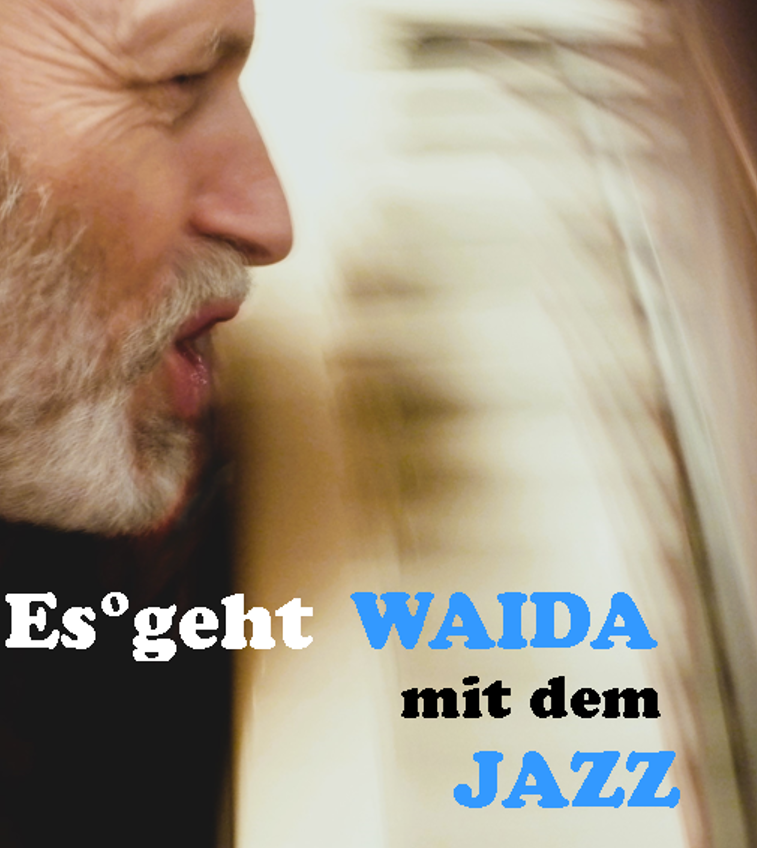
For me the real magic of “WAIDA with JAZZ” is in its very incompleteness. It’s a road on which the turns happen on their own: the next piece could completely change the feel of the thing and the rhythm. Sven WAIDA is inviting us to hear jazz as it is lived today: with the warmth of an old piano, the freedom of improvisation and the human vulnerability at its heart. And that may be the most potent idea of all: jazz begins where a person chooses to be honest, right now, in one go, with no right to a second take.
Published in partnership with SubmitHub