I don’t consider myself a garage rock fan per se; I tend to reserve that music for evenings when you just want noise and don’t want explanations. Veronica Bianqui’s new album, “Use Once Then Destroy”, has made me think again, though. In her hands, guitar rock becomes an exercise in human weakness: it starts out as all audacity, then you realise how many details have been worked to a fine art.

The album took four years to make, beginning after Bianqui moved from Los Angeles to London. It emerged from a period of loss and upheaval that changed more than her circumstances; it changed how she saw her life and her music. She made it while completing two master’s degrees at Goldsmiths: an MMus in Popular Music and an MFA in Creative Practice. For her, the line between songwriting and recording has effectively disappeared: she produced the album herself and played most of the parts, with Omar Yakar, who has worked with Courtney Barnett and Warpaint, on mixing. She remained the conductor throughout – a conductor who doesn’t know the ending in advance. You follow the idea and trust your ear. Can you hear it? Yes, and that’s what I find most compelling. The corners aren’t smoothed over, the guitars are occasionally rather dirty, and the rhythm sometimes runs ahead of itself, but it all works. The downside is that a few tracks in the middle share the same mood and texture, and the roughness starts to feel like a trademark rather than a necessity.
The 11 songs are populated by grotesques: obsessive lovers, femme fatales, self-destructive rebels. Bianqui takes familiar rock ’n’ roll tropes, exaggerates them and turns them upside down. Black humour is the scalpel, while satire and confession coexist, because beneath the grotesque lie obsession, desire, power and transience. The question is whether she always subverts the cliché rather than simply repeating it ironically.
Start with the prickliest: “Gotta Be a Man.” The heroine is told she has no place in the rock scene without “male status.” Her revenge is simple: she seduces the prick and tells him she’s already been in bed with his girlfriend. It’s brash, staccato rock ’n’ roll with a raised-eyebrow vocal – no lecture needed, and the moral lands perfectly. From mockery to the hunt: in “Do Bad to You,” the heroine tracks down a “bad boy” in order to be worse than he is. Daggers, pistols and flirtation add up to a very dark comic book, with loose guitars and a melody that is instantly catchy.

Then the excitement fades into insomnia. “Shook Up” is a buzzing head, Mercury in retrograde and an ex who is thriving while you sit in the waiting room of life. The rhythm keeps breaking step, like a syncopation in which the heart outruns the metronome. Anxiety becomes rhythm: teeth grind in time with the pulse, and the heroine sits down at the drums anyway. “Rock N Roll” is a confession with a list of grievances, where no one is to blame but the narrator. The girl dreamed of fame; the adult numbs the pain with whatever she can find; the devil is more of a joke. The sound is smoky and raspy, and you want to shout the chorus with her.
The emotional crack comes on “All My Heroes Are Dead,” the album’s most vulnerable moment: garage punk with a hooligan’s delivery and complete weariness. The heroine admits that, instead of doing something impulsive and stupid, she bought hair lightener – trying to change her inner status through outer veneer. Her voice is sober and furious: the idols are gone, but life goes on. The title track begins bluesily, with a folkish melancholy, before swelling into dense, sensual rock. It’s a portrait of a Bonnie-and-Clyde-style femme fatale: she lives fast and uses men once. Outwardly cold, inside she wants love but doesn’t know how to play nice. Bianqui’s vocals here are hypnotic – a slow theme after a turbulent set. The finale, “Money,” is a punk anthem against patriarchy and capitalism: they sell us dreams so we can fund other people’s limousines. Exhaustion, insecurity and bills drive the heroine to scream “burn it all down” – there’s no money, but there’s a soul. Bianqui fuses hyperpop, hip-hop, folk rock and glitch; the “money, money” refrain is easygoing at first, then irritating, much like the obsession with money itself. The concept is strong, even if the satire occasionally gets stuck in its own device.
Bianqui’s Californian roots show in the local scene’s blend of garage rock, punk, psychedelia and indie pop. Her touchstones include Ty Segall’s dirty but melodic drive, Kera and the Lesbians’ genre freedom and queer openness, and Joel Jerome’s idea of the studio as home. Add Amy Winehouse’s honesty and a love of 1960s French pop and girl groups, and her choruses sound like naive girl-group hits over thundering garage guitars – exactly the “classic pop craftsmanship with a punk edge” she promises.
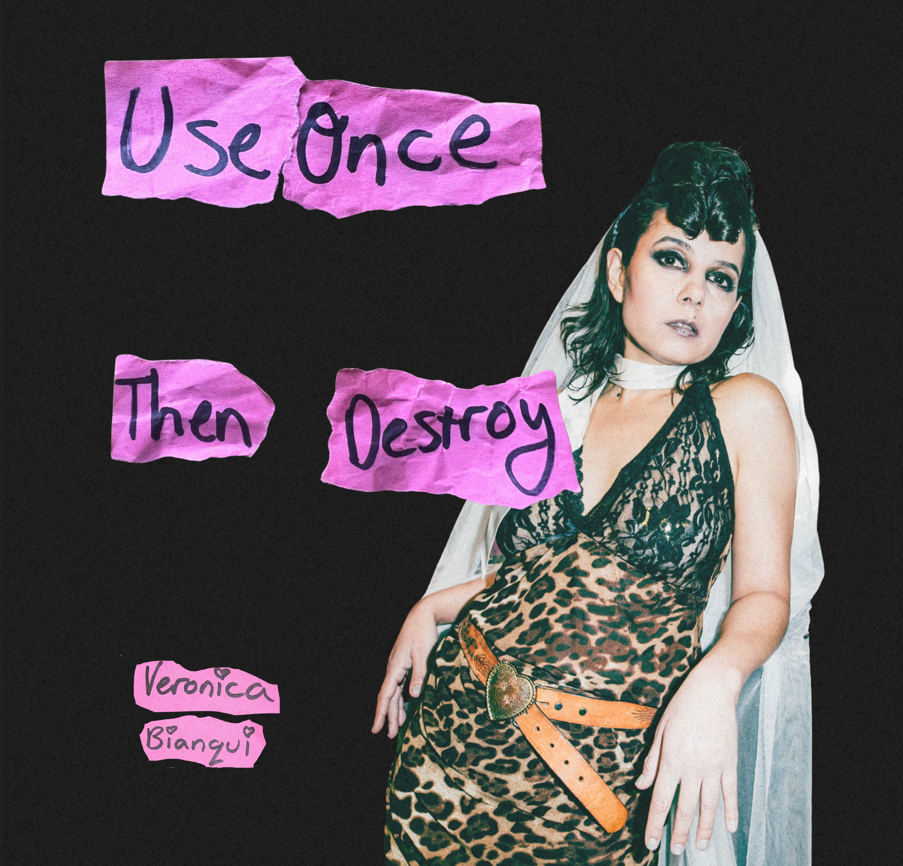
I haven’t heard her live, so I can’t judge how these songs work onstage. But judging by “Use Once Then Destroy”, it would be loud and interesting.
Veronica Bianqui has made an album that is strongest where irony leaves room for real feeling. Garage rock will still be music for special occasions for me, but this one may have to be played on ordinary evenings too – to hear again how satire turns into confession.
Published in partnership with SubmitHub