Falling asleep isn’t easy: thoughts going in circles, the phone winking with notifications, and silence feeling too loud. Composer Tim Corpus, it seems, has found a solution – and recorded it. For ten years he has been writing music for film, stage, and media projects: his works have sounded in Carnegie Hall, performed by the Chicago Symphony Orchestra at the Ravinia festival, and at the Kennedy Center. After the pandemic-era MMXX (2021) and the conceptual Alphabet (2023), Corpus takes on a task that’s even more personal – helping the listener fall asleep. His new album Place of Rest is 90 minutes of ambient music, leading from anxious wakefulness to deep sleep: five standalone tracks and a continuous full version for those who want to close their eyes. We talked with Tim about what calm sounds like, what frequency 432 Hz has to do with it – and why a soundtrack for a space video game still remains a dream.
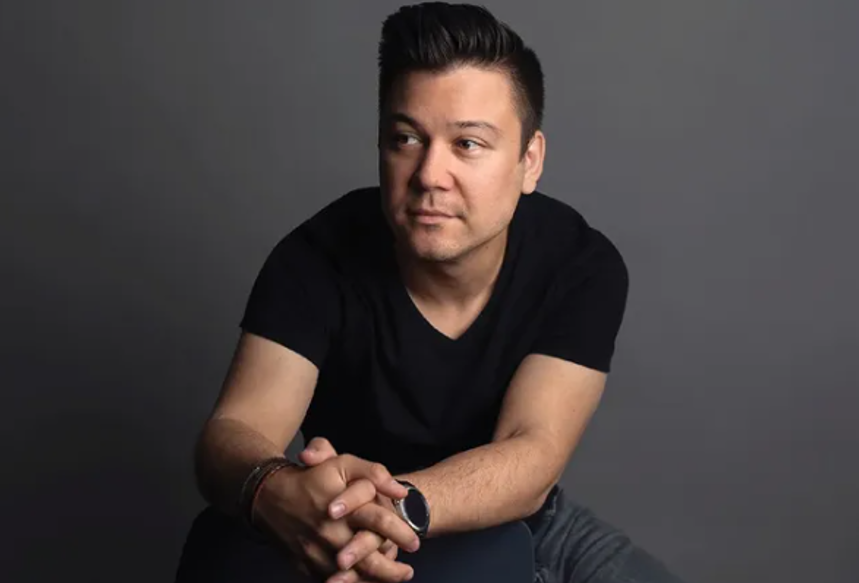
Tim, hello! Nice to meet you, and thank you for finding the time to talk, considering your new album is dedicated to sleep, I hope I’m not taking away your precious hours of rest. Let’s start from afar: if you had to introduce yourself to someone who has never heard your music but sleeps perfectly well at night, what would you say?
I would say my music is melodic, textural, and approachable. Whether you want to escape from the constant notifications of the day or listen to a little adventure, my music is about having an experience.
You’ve been writing music for stage, film, and media projects for ten years now. Looking back- would you recognize your ten-years-ago self in who you’ve become today?
Ten years ago I had a completely different life, simultaneously composing while also leading education programs for the Northwest Indiana Symphony Orchestra and serving as the Executive Director for the Hyde Park Youth Symphony. As a composer, I think ten years ago I was beginning a new phase in my writing style, just developing this more textural sound that you hear in “Place of Rest”. I think the roots of my work still connect me to my ten-years-ago self. I still listen to and love a lot of the same music, and I still have my beagle by my side every day I compose – he’s fourteen now. I am so proud of the music that I’ve been able to write over the last decade and the opportunities to share it with audiences around the globe. The experiences over the last decade have really shaped who I am today as an artist.
Your works have been performed at Carnegie Hall, with the Chicago Symphony Orchestra, at the Kennedy Center. Do you ever feel that after such venues it’s hard to surprise anyone-or, on the contrary, does the bar only keep rising each time?
I still get the same nerves every time my music is performed live or a film is screened. Whether it’s the Chicago Symphony Orchestra or the United High School Marching Band, there is still such a thrill from hearing my music for the first time. I think for audiences, hearing a living composer’s music is often a unique experience, so there is still so much of a relationship developing between me and the listener. I’ve certainly gotten better at working with the nerves and writing better music for the performers, but even though the venues may be a little bit bigger, it’s still a very human experience.
Film, live performances, media projects-you work across very different formats. Which of them requires the most musical “discipline” from you, and which allows for the most freedom?
Working on film is certainly the most “restricting” and that’s not a bad thing. When writing for picture or a story, there is a lot of craft in the process and I’m writing music that fits the director’s vision. My goal is to be the unseen character for the audience, helping carry them from scene to scene. Meanwhile, composing a large orchestral work for a group like the Danville Symphony Orchestra is almost the opposite, where I’m working with a blank canvas. The blank canvas requires a different kind of discipline, forcing myself to write everyday and face those moments of writer’s block. Writing music for an album, like “MMXX”, “Alphabet”, or “Place of Rest”, is the most freeing. In these albums I’m really writing intimately for myself and the listener. There’s no director, producer, writer, or conductor involved, so it’s really open to my own artistic vision. I am also the record label, so these albums are truly raw me. I love how these albums serve as a musical playground where I can experiment and try whatever I want. Whether that’s using French Horn over electronica beats with morse code in the background, or longform drones, the application of the music is less important than the artistic process for me.
Let’s recall your past releases, they’re a great marker of time. In pandemic-stricken 2021 came MMXX, which for many became a спасение from the madness within four walls, and in 2023-the conceptual Alphabet. Tell me: after “Alphabet,” wasn’t there a temptation to release a single called “Numbers” or “Punctuation Marks” to complete the bureaucratic cycle before moving into ambient?
I have been asked about a sequel to Alphabet, and now that you mention it, I love the idea of “Punctuation”. Haha. It was really fun to play with titles of songs in “Alphabet”, really pushing the audience to dream up the world to each song through only one word. MMXX was a lot more descriptive and the music is much more related to one-another throughout the album. For example the opening track, “Grandma’s Piano”, is the same melody that closes the album in “Together Again”. And throughout the album there are hidden morse code phrases, like a person stuck in their apartment during a pandemic sending out messages to the world, hoping for a reply. “Alphabet” was more straight-forward, each track a different experience. While the tracks all flow together in the album, living within the same experience, there isn’t a specific through-line narrative. Now writing “Place of Rest”, it’s more similar to the concept album approach of MMXX, where the album is really the sum of all its parts, and no track stands alone.
So, we’ve arrived at the main point, “Place of Rest,” 90 minutes of immersive ambient designed to guide the transition from anxious wakefulness to deep sleep. Be honest: did you test the album on yourself before releasing it?
I totally did! I tried it multiple times during the writing phase and also during editing. I decided to extend the first few tracks and while laying in bed, I found certain moments would pop out, some things too distracting and some things pleasantly surprising. So this project had a larger editing phase than “Alphabet”, because I really had to take this album as a whole for 90 minutes, versus one track at a time. I’ve already received some positive feedback about the music and a request to make an 8 hour version to cover an entire night’s sleep. And actually, I had to stop mixing and mastering this album after lunch and only do it in the morning because it would make me tired. So I guess it works!
The title “Place of Rest.” Is it a metaphorical space, or does it have a very specific prototype-a room, a landscape, a memory?
I think it’s both physical and metaphorical. Your bed, couch, or favorite chair are a place of rest, they’re a safe space. Sleep is supposed to be such a safe and peaceful thing, an opportunity to not only recharge your battery, but also dream and escape. Metaphorically, I think the music, “Place of Rest”, is meant to be a 90-minute reprieve from waking fast-paced life. Whether it’s transporting the listener on a journey, aiding in bringing the listener to sleep, or it’s just something to have on in the background, the music will hopefully serve as a moment away, or a place of rest.
The album is structured as a continuous musical narrative rather than a collection of separate tracks. How did you build this dramaturgy-from active relaxation to deep wave cycles?
I was thinking about the process of falling asleep and how distractions will disturb that cozy feeling of falling asleep. So while some listeners may enjoy hearing each track individually, for those really trying to catch some shut eye, a continuous play of the 90-minute album may be a better fit. And the album is really built for a long focused listen. Each track flows right into the next as the listener falls deeper and deeper asleep. In reality, if someone is trying to fall asleep, they may only pay attention to the first 10-15 minutes, or the first two tracks, before falling asleep. If that’s the case, and the rest of the album is just a relaxing background noise for someone, then I’d call this a success.
The first track, “Deep Roots”, is kind of out of time, floating, but it’s the most active track on the album. This was meant to bring the listener in, giving lots of little auditory treats to listen to. Our world is crazy right now. Every day is an onslaught of news, updates, and notifications; so if this album serves as a little avenue of peace in someone’s week, then I feel like I’ve done a little good in this life with music.
You use the rhythm of breathing practices as part of the composition. And in the album description, there’s mention of sound therapy frequencies. Could you, in simple terms, for a reader without musical education, explain how frequency can affect the state of the body?
4-7-8 is a breathing practice made popular by Dr. Andrew Weil and it literally relaxes the body. This “uneven breathing” exercise is 4 seconds of breathing in, seven seconds of holding the breath, and then eight seconds of calmly breathing out. This process functionally resets the body and lowers your stress response and blood pressure. Several studies have shown that focused breathing is a simple and easy way to reduce anxiety and improve sleep. So the music has a moment of the recommended four repeats of 4-7-8 before relaxing into a more “normal” breathing ebb and flow.
There is also a popular belief that 432Hz is the “optimal” tone for falling asleep. The note A440 is the tuning note for an orchestra, it’s a note at 440Hz. So 432Hz is just a little bit lower. Science has not been able to prove that 432Hz is truly the best tone for sleep, but there is a lot of anecdotal evidence that this softer, lower tone helps people relax. So the album opens with the track “Deep Roots” using traditional tuning of 440Hz, and by the time we reach the fifth track of the album, “Delta”, we have now sunk to 432Hz. I liked the calm sound of the synthesizer at 432Hz blended with brown noise and a lot of reverb. This sound world felt very deep and peaceful to me, so whether it is scientifically accurate, I don’t know, but it felt right.
Over these ten years, you’ve explored many genres. Is there still some wild musical dream you haven’t realized yet? For example, writing an ambient opera or a soundtrack for a space survival video game?
A space video game soundtrack is certainly a dream project of mine! I grew up listening to the soundtracks of epic games like StarFox on the Super Nintendo and then playing Mass Effect and other space games. So one day I’d love to write a soundtrack for a modern science fiction game. I would also like to write a musical or opera one day. I enjoy so many different forms of art and they all inspire me in different ways. Listening to music has always been an inspiring and personal experience to me, so I feel like I have so much more to explore in different sound worlds.