In her primary professional activities, Devon Michael helps artists write and produce music. In addition, she works in A&R – working with numerous performers and helping develop their projects. But after many years dedicated to realizing other people’s creative visions, recently she has been increasingly focusing on her own music. This reminded me of the plot of a parable about a master who spent his whole life making mirrors that helped other people see their best traits – confidence, beauty, strength. He was so absorbed in serving others that one evening, left alone in the workshop, he wondered for the first time: what is he like himself? “And one day he decided to make a mirror not for a client – but for himself.” That seems to be what happened with Devon: first it was singles, then an EP, and she also wrote the rock track “Rearview” specifically for the feature film Grace Point. And now – the soundtrack for the short film “Grant Me the Serenity” and an original song for the picture “Embers”.

The screenwriter, director, and one of the lead actresses in “Grant Me the Serenity”, Jessica Pinfield, is connected with Devon Michael through work on the music video for “Retrograde” – the lead single of the artist’s debut EP. That music video became their first joint project.
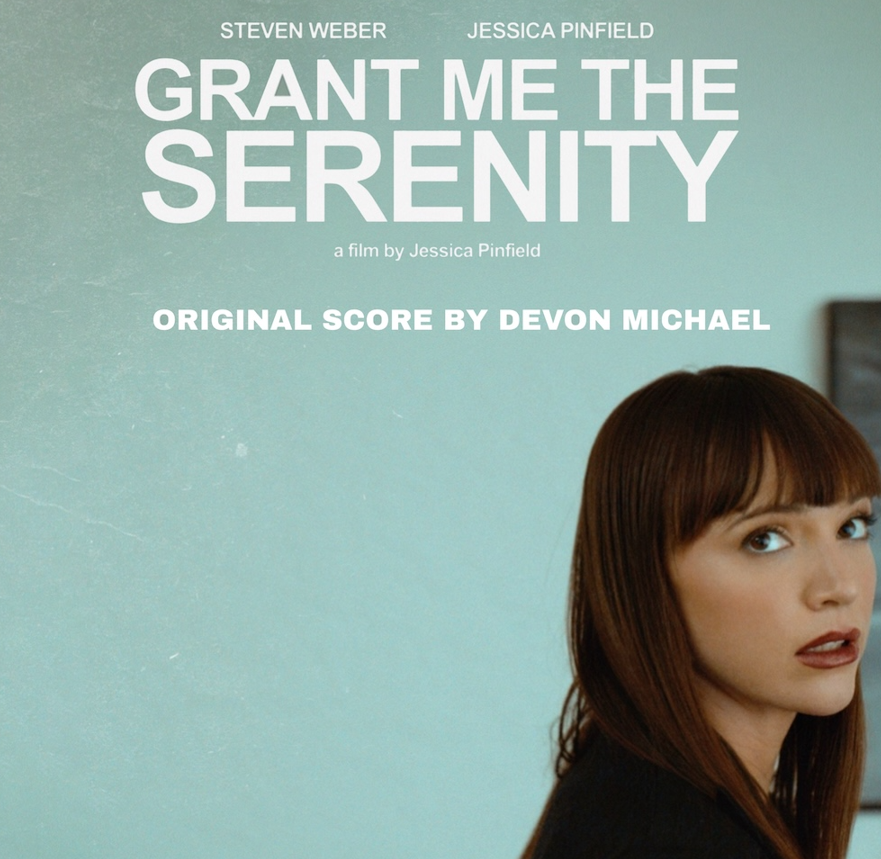
The film itself, the directorial debut of Jessica Pinfield, is deceptively simple. A father (played by Steven Weber), who is recovering from alcohol addiction, does not return home on time – and this tiny, everyday delay suddenly turns out to be a crack through which all the hard-gathered composure of his daughter slips away. The story is intimate, without external drama, but with immense internal pressure. Devon’s music is structured in precisely the same way: it lives with the same emotions as the heroine. The material is delicate, and therefore the release, consisting of just two tracks, is listened to as a standalone statement.
The record opens with “Grant Me the Serenity – Score Suite”, an orchestral suite – and here it is important to understand that what we have before us is not background film music assembled from disjointed pieces, but a cohesive work that compresses the entire emotional arc of the film. The composition opens with a tangible silence: rare piano notes hang in the void before a chamber ambient enters. But peace is only a dream for us. The author masterfully builds the dynamics: heavy industrial textures and dense bowed sections are gradually mixed into the delicate keys. The music “grows” with the weight of someone else’s guilt and uncontrollable chaos crashing down on the heroine’s shoulders. At moments of dramatic climax, the suite explodes with percussion and dense string chords.

If the suite is a large-scale drama, then the original song “Embers”, which became the emotional epilogue of the picture, is its meditative reflection. Written under the impression of the film, but taken beyond the frame, it works like an evening sketch made after the storm has already passed. Michael consciously removes orchestral splendor – there is not a single extra layer here. The keys hold the supporting structure – everything else is stripped to the limit. The title hits the essence of the plot: the song smolders – a steady, physical heat held inside at a single level. The tempo is calm – a vacuum space of silence, a barely contained balance between empathy for a loved one and the need to preserve one’s own integrity is felt. “Embers” gives the listener a breathing space after the experienced storm and an opportunity to find peace with what can no longer be changed. Knowing Devon from her past works, I was pleasantly surprised by how her vocals sounded here. It sounds closer than usual. Bitterness, anxiety, and tenderness can be heard in the voice, without an attempt to choose just one. The vocals go ahead of the instruments and lead the whole scene – not illustrating the plot of the film, but telling the rest of what remained behind the scenes.
Writing music for film is a tricky art. The composer serves someone else’s story. Good film music is valued precisely for the ability to disappear – to dissolve in the frame without claiming authorship. But in my view, the soundtrack to “Grant Me the Serenity” and the song “Embers” are a special case. Formally, Devon Michael is doing the same thing as always: giving a voice to someone else’s statement. But something here shifts – it seems the film’s material came too close to her own experience. It seems that very “mirror for oneself” turned out to be captivatingly deep for Devon Michael. Her music is capable of holding the viewer’s – and listener’s – focus no worse than a big movie.
Published in partnership with SubmitHub