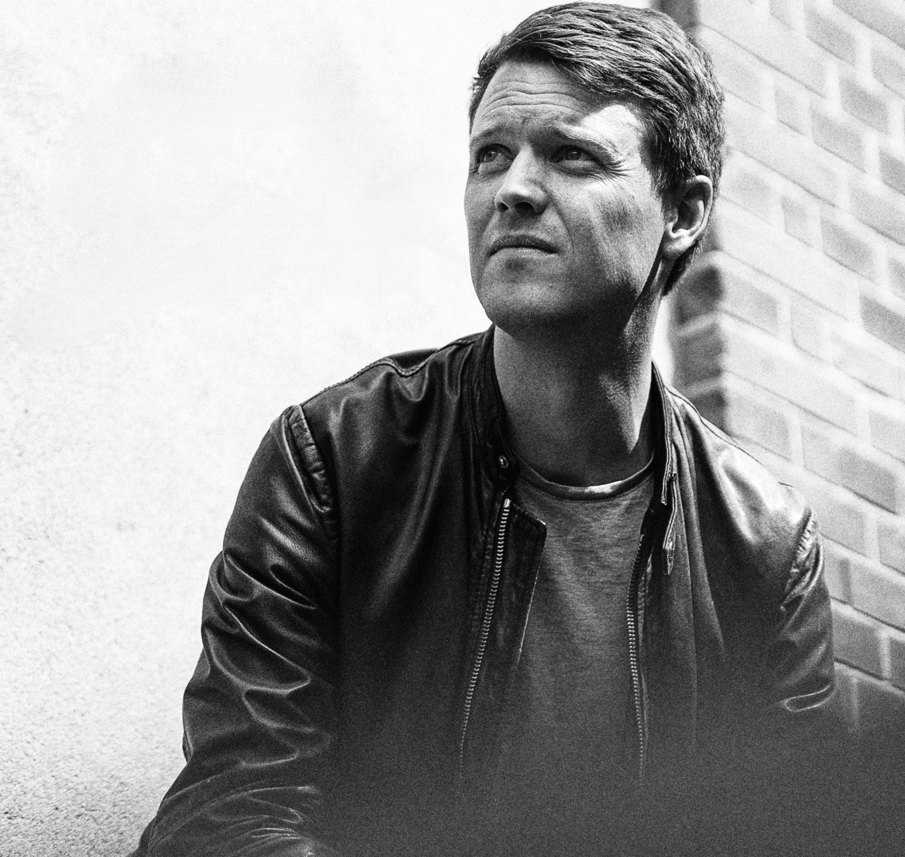
37 albums, a jazz background, a principled refusal of neural networks, and a sincere affection for rainy Great Britain – all of this is about the Longboat project. Originating in Seattle in 2011, the band has always gone beyond standard genres, easily transforming in the studio from a solo songwriter project into large-scale lineups with strings and brass. In September, Longboat returns with the release of Proud of My Postcode – a fully electronic record recorded at the legendary Strongroom Studios in Shoreditch. This is an attentive, sympathetic look by an American musician at British history, street foxes, cozy everyday life, and the small joys of life between cups of coffee and tea. We talked to the author of the album about why coffee and tea get along so well in one cup, what is bad about improvisation in the age of AI, and how one manages to release three albums at once without losing their mind.

Hi! We’re very glad to meet you and thank you for finding the time to talk. Let’s go back a little into the past. Longboat was founded in Seattle in 2011. What was the main fuel back then: jazz evenings, forest walks, or a desire to make music without compromises?
Glad to meet you, too. I really like your shoes! Thanks for interrogating me! Well, the inspiration to make a pop music album came in a flash in 2011 and has managed to sustain itself since then. There I was, writing a few unserious songs for fun and then I alighted on the idea of writing an entire album about Seattle, its neighborhoods and suburbs. It was called – no surprise here – Greater Seattle, and the entire experience was so positive and gratifying that I vowed to recreate it as often as I possibly could. So far, that’s resulted in 37 albums.
From Seattle to London. It seems these two cities were made for each other: in one place they invented espresso to wake up on a cloudy day, and in the other – tea, to get through foggy evenings. Tell me, was the move across the ocean a smooth transition from a cup of Colombian coffee to a mug of Earl Grey, or did Britain present some unexpected surprises?
Seattle and London share remarkably similar weather. But the comparisons kind of end right there. London tries to maintain a vision of the future while preserving its storied past, while Seattle still hasn’t determined what its place is in the general scheme of things. It’s a young city, so there’s a process, I guess. There’s also a difference in tempo. London is quite bustling and Seattle is more relaxed. I prefer bustling and I really favor rainy climates. I get a lot of music written while it rains. Also, I’m both a coffee and tea drinker, so there’s no beverage culture shock. I’ve spent enough time in the UK for it to feel like home. I still don’t understand the appeal of Morris dancing, though.
You say you don’t write “love songs,” but observation-music. What do you “spy on” most often: queues, the weather, conversations in pubs, or something completely unexpected?
My inspiration for songs comes from everywhere and is usually generated in the schizophrenia of the moment: I hear a snippet of music in one ear, then a word or a phrase whispers in the other and that becomes a tune, as improbable as it might sound. I don’t want to analyze it too closely for fear of making the process too uniform or predictable, and taking away the odd magic of the moment. My craft thrives on the random and unexpected.
Let’s go back to Longboat. They say Longboat in the studio is most often one person, and at concerts – a whole army of rockers, jazz musicians, and a string section. How do you decide when it’s time to call in reinforcements?
It’s actually the opposite. In the studio, I muster a variety of band formats from jazz and rock groups to small string orchestras to electronics, depending on what any given album needs to sound like. Lately, though, I’ve been taking those tunes and converting them into versions for solo piano for me to sing around London. Sometimes, I’ll just order a pint and hammer away on the rickety house upright or I’m playing a portable Roland digital piano in my lovely neighborhood of Clerkenwell. I’ve found that the smaller the ensemble, the more directly you can reach an audience. Now, I have nothing against singing in front of a symphony orchestra, but that opportunity hasn’t presented itself yet. Until then, I’m going to keep it small and mobile.
You’re a professional jazz tenor saxophonist. Jazz musicians are known for their love of complex chords, while electronic music is known for a good beat. How does a saxophonist get along with synthesizers?
A lot of my earlier music is what I’d term “chord heavy.” It comes from the jazz practice of letting shifting chords guide the melodic writing. Since then, I’ve explored roots, blues and folk, which tends to be more harmonically stable. But the one thing that I still retain from my jazz playing days is the solo break. The improvised solo is going the way of the fax machine throughout pop music, but I still like to present a contrast that eventually becomes an extra melody on repeated listening. As for navigating my way through electronics, I have no problem with them. The strength of every song is in the arrangement and when I’m working with electronic tracks, I am very meticulous about what goes into each tune. So yes, electronics are fine, but AI is a different story and one that is an existential threat to all creative ventures.
Let’s talk about numbers that make your head spin a little. The 37th album. For some bands, by their 37th year of existence, only their third release comes out. What’s your secret to such productivity – coffee from Seattle or British tea?
Both coffee and tea! When I make albums, I tend to write them in groups, sometimes three at a time. By doing that, I try to be at the same stage with all the songs at the same time. The tune goes from song start, generally a verse-chorus framework, to an arrangement that takes it to a full-length track with a complete arrangement. Once that’s done, the lyrics join the party. They’re always about something coherent. I don’t like to write songs about nothing. I tend to focus sometimes on themes and concepts. But timing is important in the process. If an album has 12 tracks, I try to finish them all at the same time. The intent is the same if I’m writing three albums, all containing 12 or so tracks. Of course, there are always problem children among any group of tunes, but knocking those into shape is always satisfying. Many of those tend to be my favorites on any given album.
The new album “Proud of My Postcode” is inspired by Britain, London, and everyday life. Which most “British” detail ended up in the album by accident, and which one deliberately?
I always like to claim that everything is deliberate, but I’d have to say that “A Fox in Hoxton” pretty much came into being by chance. My wife and I saw our first London fox when we were in Hoxton, I just never phrased it like that until I was trying to write lyrics for this cute little disco tune. It’s basically about nature waiting to take over again. When that happens the foxes will be everywhere, not just in Hoxton.
The album is entirely electronic, and you fundamentally don’t use artificial intelligence in writing and recording music. Was that an easy decision to make once – or do you have to reaffirm it every time?
It’s a very easy decision. One way, you’re crafting music; the other, you’re cheating. AI has no appeal to me because I enjoy making music. I nurture an idea from beginning to end, thoroughly enjoying every step of the process. Now, if I had no music skills, I might consider it, but as it stands, I love making music and do not consider AI to be an option. It’s compilation, not creativity.
You mention that the album moves between the country’s past and present. What does that feel like technically in the writing process?
It’s funny, but almost every track, except of course for “A Fox in Hoxton,” pretty much told me in advance what it wanted to be about, so I structured the writing around the subject matter. Some tunes are happy, others grim and others still conjure the supernatural and the ancient.
When an American confesses their love for Britain, everyone expects an ode to Big Ben or the Queen. But you focus on everyday life instead. Is there a track on the album that was born from something completely simple – a queue at the bakery, a conversation with a neighbor, a ride on a crowded bus? Or are such moments still just piling up in a notebook – for album number 38?
Oh, album 38 is already done! It continues the ramble across the windswept moors of Holborn, Chelsea and beyond, through the past, present and future of the real and the mythical. But for this album, my wife is particularly interested in mudlarking, but hasn’t actually done it yet. With “Mudlark Life,” I just wanted to encourage her to keep up the enthusiasm. Someday, we’ll be poking at random shiny things while the Thames is at low tide!