“Space is not that far away. It’s only an hour’s drive if your car can go straight up,” British astrophysicist Fred Hoyle once joked. But if we set aside earthly mechanics, music, in my view, has handled this route faster than any shuttle. It is capable of traversing light-years in a fraction of a second, transforming cold infinity into emotion. The Sydney quartet Ephemera, led by composer and multi-instrumentalist Keyna Wilkins, has been engaged in this kind of mental cosmonautics for more than ten years. Their new, third full-length “Star Opus” offers the listener a kind of sonic telescope, where experimental jazz and academic avant-garde collide with the true breath of the Universe. At the core of the concept is a bold conceptual move. Real NASA recordings are used as sound material – electromagnetic waves captured from planets and stars, selected by astronomer Paul Francis. On the album, the NASA recordings effectively act as co-authors; they are a full-fledged voice. The rest of the space is constructed by four musicians-pianist Keyna Wilkins, double bassist Elsen Price, trumpeter Will Gilbert, and drummer Jodie Michael.
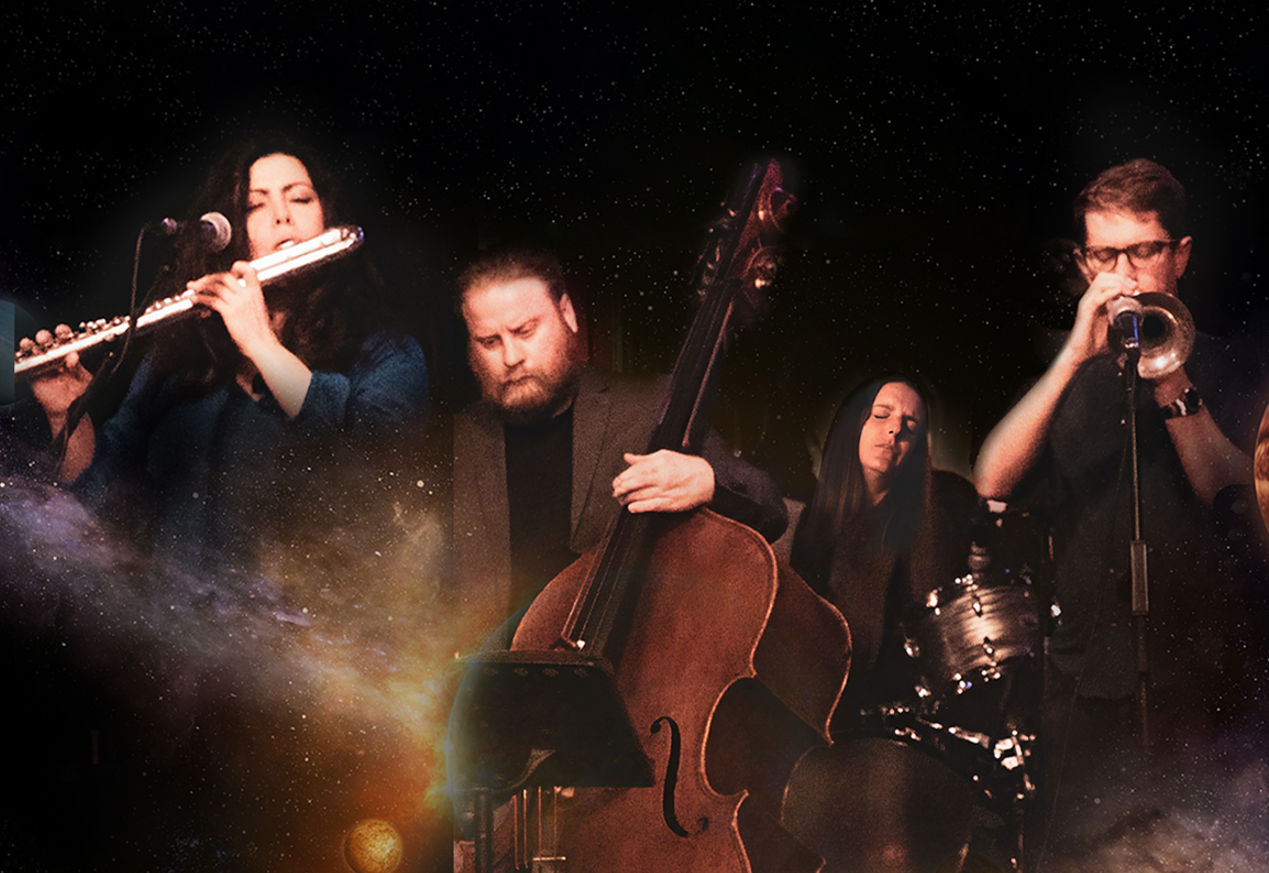
The six compositions of the album are sustained in a structured stylistic framework with daring freely improvised fragments. For the most part, these are long, meditative pieces, largely based on the principles of experimental jazz and contemporary classical music. The album opens with “Stellar Parallax,” a lesson in perspective. Piano, trumpet, and double bass conduct a conversation around the idea of parallax-the distance that changes depending on where you stand. Wilkins’ composition embodies this shift: the same melody sounds different from each instrument-and only then releases itself into improvisation, as if casting off moorings. Will Gilbert’s trumpet charts the route, Elsen Price’s double bass keeps the fragile structure from falling apart, and Wilkins’ piano sets a strict, mathematical motion that imitates the visible displacement of stars. This is music of distances – between points, thoughts, and worlds. Stylistically, from the very first track the musicians clearly demonstrate their commitment to free improvisation.
In the composition “Asteroid Vesta,” the piano gives way to the flute, and the texture changes weight. The music is weightless – befitting the portrait of the brightest asteroid of the main belt. The trumpet circles around the melodic line like a celestial body in orbit: it never collides, but never drifts too far away. The angular bends of the flute parts echo the nervous, dry phrases of the trumpet. The double bass weaves a dense, tangible texture; one can feel the wandering of a solitary stone giant in the dark. The first turning point in the album occurs in the composition “Mercury Rising.” It is a collective improvisation grown from real sounds of Mercury’s surface, recorded by the Messenger probe in 2008. The trumpet, flute, and drums work with this material like archaeologists. Jodi’s drums introduce a pulsating dynamic, while the trumpet and flute conduct a dialogue that at times resembles radio interference. The result is abrasive and mesmerizing. Such an unusual combination of musical principles gives Ephemera’s music a completely distinctive color.
This can be verified by listening to the composition “Oceans of Venus.” The most cinematic and multilayered piece on the album. A violin joins the familiar trio, adding a piercing, earthly melancholy to the sound. The piece unfolds slowly-as if through the dense clouds of Venus the outlines of what is hidden below gradually emerge: oceans that are no longer there. The dialogue between piano and strings here reaches a peak of drama-high neoclassicism washed by jazz tides. Against the backdrop of “Oceans of Venus,” the piece “Lunar Eclipse” sounds more restrained. A lunar eclipse is, first of all, a perfect alignment: three bodies that find the exact moment. This piece has the same geometry. Four musicians-double bass, trumpet, drums, keyboards-move like celestial bodies that know when to intersect and when to yield. In this composition it is especially clear how Ephemera work with space: each sound leaves behind a long, visual trace. The final piece “Pluto” leads to the periphery of the Solar System. It is a collective improvisation based on the sounds of Pluto, obtained by the New Horizons mission in 2015, and the sonification of its geographical data-icy mountains, nitrogen plains. Ephemera abandons attempts at structuring and offers pure improvisation of flute, trumpet, and double bass. The sounds seem rarefied, frozen in time, leaving the listener one on one with the frightening and mesmerizing emptiness of boundless space.
“Star Opus” is an album for listeners who share the musicians’ love for this style. And if you do like it, you will certainly appreciate both the musicians’ imagination, their technical mastery in extracting the most unusual sounds, and their level of interaction. And now, when you have finished reading, put everything aside and listen to this music. The release of Ephemera’s album can be called one of the most extraordinary and luminous jazz events of the year.