“There is a crack in everything, that’s how the light gets in”. This is how Leonard Cohen once subtly formulated the main wisdom of North American poetry: true beauty is rarely monolithic. It manifests itself where the familiar world develops a crack. Geography is made up of a set of coordinates on a map, but it is also a state of mind. Especially when we are talking about places where it is cold, damp and beautiful. The new project Velour On Tap, behind which stands musician I. D. Brimacombe, offers the listener exactly such an adventure. Having passed through the experience of living in London, Lisbon, Chicago and Montreal, the musician eventually settled in Halifax, Nova Scotia. And the harsh coastal region became the setting for his debut mini-album.

The EP “Cruel Harbour” is an exquisite psychogeography of the North Atlantic coast, rendered in the gloomy tones of “sea gothic”. Here, the quiet claustrophobia of provincial resort towns collides with the sharp, icy breath of the Atlantic. Musically, I. D. Brimacombe draws inspiration from the melodically dissonant pop sound of Halifax and Moncton circa the early 90s, while poetically he stands alongside the great Canadian narrators – Cohen himself, Dan Bejar and John K. Samson. Before the listener are four sketch-like tracks, four fragmentary guides to human disorientation among abandoned gas stations, quarry lakes and foggy highways.
The Atlantic guide opens with the track “Hourglass Lake Ahead”, which sets the atmosphere for the entire release. Nostalgic guitar picking and a soft, hypnotic drum rhythm gently envelop the listener. The entering two-part vocal adds volume to the sound, behind which bold, dark textures quickly emerge. “Hourglass Lake Ahead” is a kind of surrealistic sketch about a small resort settlement. Behind the glossy picture of a postcard, the author notices dull boredom, old psychological traumas and poverty. Hourglass Lake is, essentially, a picturesque hourglass. Nature here is incredibly beautiful, but with a bitter edge: it stubbornly hints that time is running out, and everything beautiful sooner or later withers.

The smooth meditativeness of the first track gives way to growing inner tension. “Gas Station Map” picks up the listener and carries them away on an anxious night voyage. At the heart of the track are a dense bass and smooth, tangible guitar lines. The music drags you along into a night drive saturated with paranoia, danger and a sticky feeling of betrayal. The author masterfully assembles a nightmare out of ordinary everyday life: neon signs of cheap gas stations, a crumpled map on the seat, a missed route and a passenger who was just there – and suddenly disappeared. The ending of the track remains open, hanging in the space between catastrophe, an absurd accident and the final collapse of a relationship.
From the atmosphere of a nocturnal escape, the record moves into deep inner reflection. “Sand in the Hardest Shell” sounds deliberately balanced: the guitars glide across the surface, only occasionally sinking into sombre, heavy chords, while the drums hammer out a perfectly even, hypnotic rhythm. In terms of meaning, this is the most poetically complex track on the EP. A song about nostalgia for a past that seemed grand and bright in memory, but upon closer examination turned out to be an emotional wasteland. Through a chain of surreal images, a physical feeling of mental disintegration is conveyed. The past slips through the fingers, leaving only absurdity and the realization that the future as it was conceived will never arrive.
The final chord of the EP sounds like a bright, but bitter epilogue. The instrumental parts become noticeably softer, the vocal acquires an unexpected warmth, and only the drums retain their convincing, confident drive, keeping the song from falling into sentimentality. “Eagles Have Angles” is a meditation on the elusiveness of perception and the impossibility of holding on to what is leaving. From the external landscape, the protagonist finally moves into the inner world, where eagles, foggy shadows and ghosts of the past change their forms depending on the angle from which they are viewed. The concluding fragment with a clumsy, unsuccessful séance draws a line under the entire work. But behind this bitterness lies consolation: if beauty and happiness are not eternal, then even pain, disorientation and despair sooner or later come to an end.
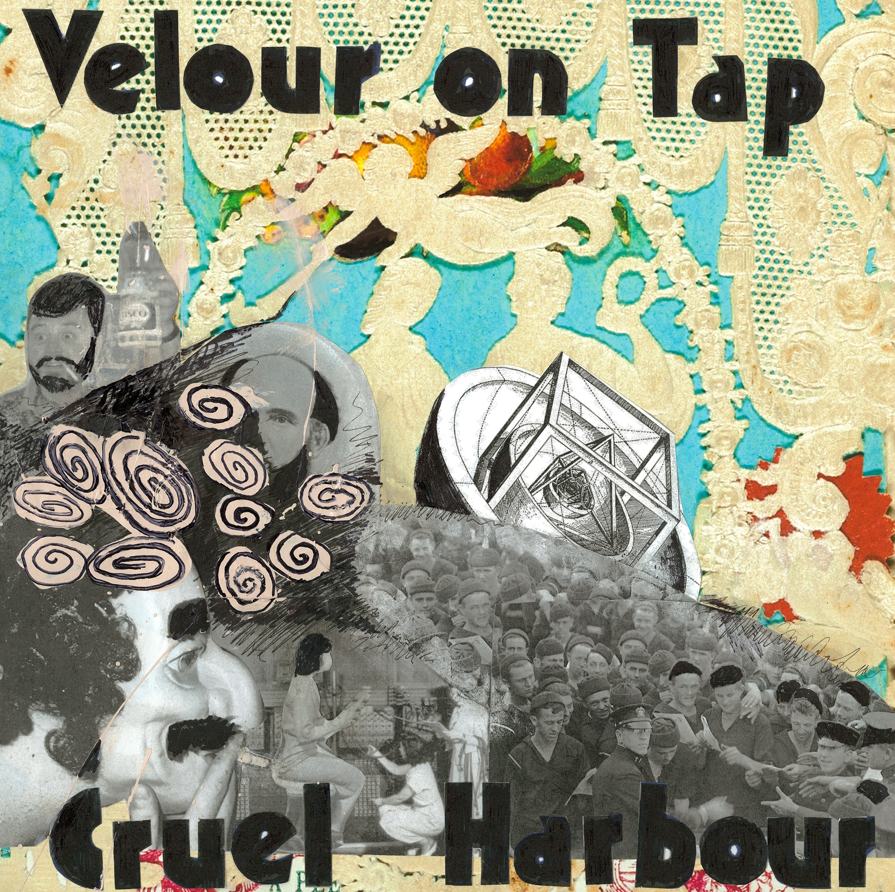
“Cruel Harbour” by Velour On Tap lasts only four songs, but manages to lead the listener through an entire psychogeography – from the lake to the gas station, from the gas station to the memory, from the memory to the point of view under which even it itself falls apart. A debut that speaks quietly, in fragments, trusting the listener to assemble the map themselves from details that seem to lose their meaning – but in the loss of meaning, as Cohen taught, the light gets in.